Simplifying Healthcare with Smart Patient Management System
- Home
- Case Studies
- Simplifying Healthcare with Smart Patient Management System
New Delhi, India
Hospital
Real-time patient monitoring , Inventory management, Environmental Monitoring, Patient flow optimization
Project Highlights
- The client wanted to develop an end-to-end hospital and patient management system as an innovative product to help healthcare businesses manage their staff, patients, and physicians.
- The objective of developing a patient management system is to create a scalable and effective system within a hospital, that will facilitate the seamless operations of all medical departments.
- PsiBorg Technologies partnered with the client to develop a smart hospital management system that allows doctors, patients, and healthcare staff to interact with each other and facilitates healthcare operations from anywhere at any time.
- We developed an IoT-enabled smart hospital management system that features a displaying unit to show information about doctors’ appointment times and visiting hours, enabling patients to schedule appointments, and improving pharmacy management.
- Our team developed a solution, which combines hardware and software, to create a smart healthcare system. The software part includes four essential modules: the super admin module, the doctor’s module, the appointment module, and the pharmacy module. Whereas the hardware component included the development of temperature, air quality, and water quality sensor nodes.
Client Name- Pherious Inventions
About the Project
The client was looking for a new and innovative approach to transform the healthcare industry by utilizing IoT technology to streamline hospital operations and enhance patient care while keeping costs down.
There’s a lot of paperwork in a hospital, client wanted to automate the paperwork to ease the stress on the staff and medical professionals.
They briefed us about their idea of developing an intricate smart patient management system and a hospital appointment management system to control hospital operations and data flow.
Our Innovative Solution
These challenges can be successfully mitigated by integrating a smart patient management system, which will improve patient flow, cut down on wait times, and boost overall operational efficiency.
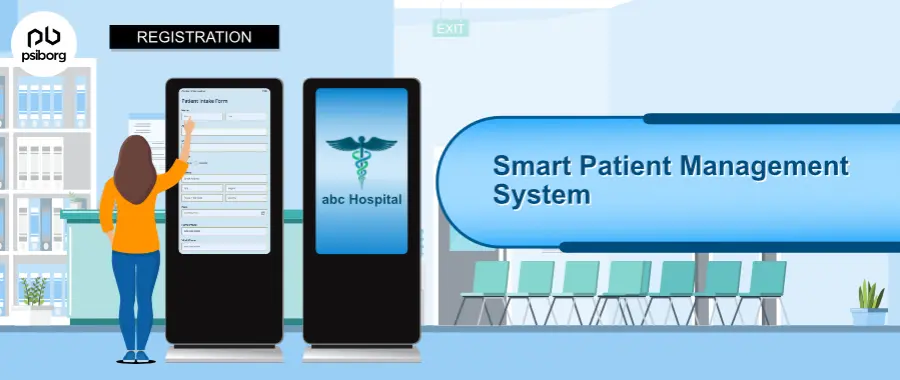
Understanding the requirement, we developed a smart hospital management system solution that allows the registration process through a kiosk integrated with IoT technology and cloud technology for safer connectivity and data sharing.
Patients can schedule an appointment via the kiosk and monitor their basic health parameters as soon as they arrive at the hospital by utilizing the smart patient appointment management system.
Along with the IoT device-integrated kiosk, we developed hospital management software with four key panels- A super admin panel, a doctor’s panel, a patient appointment panel, and a pharmacy panel.
The super admin panel is designed to manage and oversee all aspects of a hospital’s operations.
Through the doctor’s panel, doctors can access electronic health records and treatment plans, thus increasing the efficiency of medical professionals.
The appointment panel is designed to simplify scheduling and improve patient experience. The appointment management system reduces wait times and improves the clinical flow.
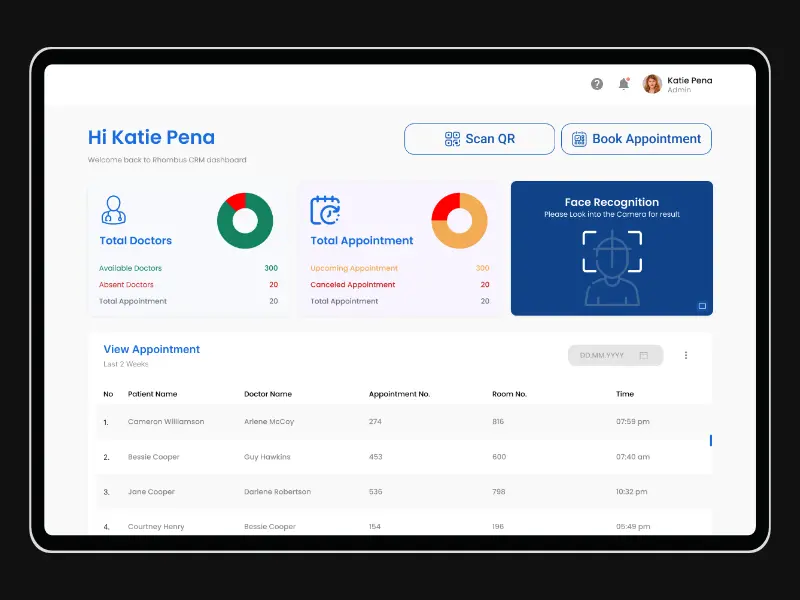
Whereas, the pharmacy panel is developed to manage pharmaceutical inventory.
We developed a smart hospital management system with the following features:
- Patient management with a full history of payments and cases.
- Doctor management with their departments & specialties
- Medicines management with its basic stock inventory
- Patients’ and doctors’ appointment management based on availability
- Super admin dashboard with a full overview of the whole system
- Manage reports of patients
Features
1
Pharmacy Management
The smart solution automates pharmacy inventory, prescription management, and medication tracking to ensure the timely availability of drugs, thus reducing errors in dispensing.
2
Lab Management
In hospital laboratories, the system is utilized to streamline test results, and lab workflow, and reduce turnaround time for the diagnosis of patients.
3
Appointment Scheduling
The smart system facilitates easy online scheduling, rescheduling, and reminders to better optimize the use of healthcare resources.
4
Patient Registration
The system digitizes patient onboarding, and collects personal, medical, and insurance data efficiently, minimizing paperwork and speeding up the patient registration process.
5
Electronic Medical Records
The system provides centralized patient data, medical history, appointments, prescriptions, and everything in one place, improving coordination and decision-making.
6
Reporting and Data Analytics
Using the system, you will get detailed insights into patient trends and operational efficiency, helping in strategically planning and improving healthcare services.
Technology Used





We at PsiBorg are a click away. Please mail to us at info@psiborg.in
Just in case you need to understand anything and everything about IoT, Project requirement.
Project Challenges
A healthcare ecosystem faces a myriad of challenges, be it managing huge patient data, healthcare services, or supporting information needs for patients.
Moreover, the challenge that the healthcare industry faces that needs to be resolved is increased waiting time due to voluminous patient flow.
Patients are not the only ones affected by this problem; healthcare professionals are also under pressure, which could result in lower productivity and possibly lower-quality patient care.
Result
The smart hospital management system improves the informational content of healthcare documents and automates the process to minimize the forgetfulness and inattention of the staff while registering patients.
PsiBorg developed an IoT-enabled smart hospital management system that aims to bring numerous benefits to the healthcare industry.
The product we delivered to the client offers the following benefits:
- High productivity, reduced cost and workload
- Improved patient experience
- Patient data security
- Streamlined workflows
- Automated reporting
- Centralized administrative control
What We Delivered
- Kiosk with tablet screen
- Android App
- Documentations
FAQs
How is an IoT-enabled hospital management system different from traditional hospital management software?
A traditional hospital management system is software that relies on staff entering data manually at counters and desks. An IoT-enabled system adds a physical layer of kiosks, sensors and gateways that capture data automatically, such as check-in details, basic health readings and room temperature or air quality. That information reaches doctors, pharmacy and administrators through the cloud in real time instead of at end-of-day entry.
Can a smart patient management system integrate with an existing HIS, EMR or India’s ABDM/ABHA?
Yes, usually through APIs or an integration layer connecting the kiosk, cloud backend and the hospital’s existing HIS or EMR. Healthcare data exchange commonly relies on HL7 standards, and India’s ABDM specifies HL7 FHIR R4 records. ABDM certification is milestone-based: M1 covers ABHA creation and verification, M2 serving records on patient consent, and M3 consent-based data fetching.
What data privacy rules apply to a patient management system in India, and how should IoT kiosks protect patient data?
Under the Digital Personal Data Protection (DPDP) Act, 2023, and its 2025 Rules, hospitals act as data fiduciaries. They need consent or another lawful basis, reasonable security safeguards, and breach notification to the Data Protection Board and affected patients. Penalties can reach INR 250 crore per contravention. At device level, kiosks should collect only necessary data, encrypt it in transit and at rest, use role-based access with audit logs, and clear screens after each session.
Which wireless technology is best for hospital sensor networks: Wi-Fi, BLE, Zigbee or LoRaWAN?
It depends on data rate, battery life and coverage. Wi-Fi offers high throughput but draws more power. BLE is low-power and short-range, suited to tags and nearby devices. Zigbee supports multi-hop mesh networking but coexists poorly with crowded Wi-Fi. LoRaWAN uses sub-GHz radio for small, infrequent readings like temperature, with long range and low power.
How should a hospital pilot and scale an IoT-based patient management system without disrupting daily operations?
Look for in-house capability across the whole stack: hardware and PCB design, firmware, cloud, dashboards and mobile apps, since gaps between these teams are a common project risk. Ask for healthcare or regulated-sector references, a data-security approach aligned with DPDP, documented testing of hardware, firmware and software, and written terms on source-code and IP ownership, documentation handover and post-launch support.