Manpower and Trolley Tracking in Automotive Industries
- Home
- Case Studies
- Manpower and Trolley Tracking in Automotive Industries
India
Monitoring and Tracking
Labor Productivity Analysis, Quality Control, Safety and Incident Management
Project Highlights
- An IoT-based Manpower Tracking and Monitoring System offers real-time monitoring of worker productivity, safety, and location across a range of industries, including manufacturing, healthcare, and automotive industries.
- DENSO is a global manufacturer of automotive components, offering advanced automotive technology, systems, and products. The second-largest automotive manufacturer in the world, which deals in manufacturing cars like Ford, Nissan, Honda, and Toyota.
- They wanted us to build a custom-based manpower and trolley tracking and monitoring system that would allow them to track workers and trolleys to improve productivity, ensure accountability, manage variable pay, meet data security requirements, and so on.
- The IoT-based manpower tracking system offers real-time location tracking by allowing management to monitor workers locations and productivity easily. Key features include automated attendance reports, an intuitive IoT dashboard for centralized data visualization, and safety alerts that notify supervisors of unauthorized access or emergencies.

Client Name- Denso
Our Innovative Solution
To address these challenges, a dynamic approach was adopted by the PsiBorg Team for designing and implementing the manpower and equipment tracking system.
Our Team first did a thorough research and analysis of client requirements and pointed out the key points to customize the Manpower Tracking and Monitoring System accordingly.
As a result, we chose a custom-built solution that integrates various IoT hardware components including BLE beacons, BLE tags, and smart wearables along with a centralized IoT dashboard for real-time monitoring.
Understanding the importance of data accuracy and safety, the PsiBorg designed the system to collect critical metrics such as location data, movement patterns and heat maps ensuring a comprehensive overview of workers performance and welfare.
For a smooth transition, we offered training sessions for managers and workers, giving them with the knowledge to effectively utilize the system and its benefits.
The main points of developing this innovative manpower tracking system include:
- Real-Time Data Collection: Continuous monitoring of critical metrics like location and movement patterns, with additional features such as body temperature and heart rate coming soon to ensure safety and productivity
- Centralized Dashboard: A user-friendly IoT dashboard that allows managers to visualize real-time data and generate actionable insights for decision-making.
- Automated Alerts: Real-time notifications for emergencies, unauthorized access or deviations from protocols to enhance workplace safety.
- Scalability and Adaptability: A system designed to grow with the organization that is capable of handling increased data loads and user demands without compromising performance.
What We Delivered

User friendly dashboard

Beacons for trolley and manpower tracking
Features
1
Real-time Location Tracking
It helps the supervisor to see the workers and contractors at all times.
2
Enhanced Safety & Security of Workers
Keeping workers safe at work is very important. This system sends immediate alerts if workers or trolleys enter a restricted or dangerous place.
3
SOS Alerts
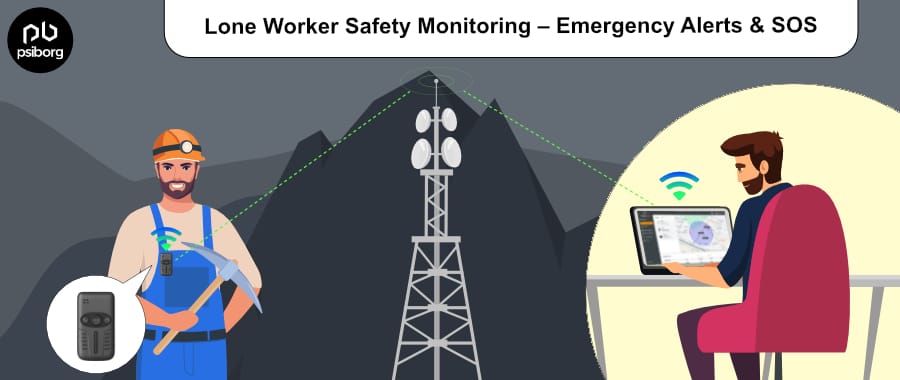
In case of an emergency, the worker can send SOS alerts from their devices to the central system or an SMS depending on the situation.
4
MIS reports
It generates detailed MIS reports that summarize key operational and productivity data, helping managers make informed decisions by analyzing workforce performance, attendance, safety incidents and more.
5
Real-time IoT Dashboards
The dashboard displays the number of workers at each location organized by their job titles and presents this information in clear graphs and images for easy understanding.
6
Geofencing
It creates virtual environments within the workspace and sends alerts if workers or equipment cross the zones.
Technology Used


We at PsiBorg are a click away. Please mail to us at info@psiborg.in
Just in case you need to understand anything and everything about IoT, Project requirement.
Project Challenges
Integrating various hardware components with the IoT dashboard required careful planning to ensure smooth communication and data accuracy.
Developing a system that efficiently processes large volumes of data in real-time presented significant technical challenges that required robust data management solutions.
Encouraging workers to utilize the new tracking system was a challenging task as they needed to communicate its benefits effectively and address any concerns regarding people tracking in the automotive industry.
In the development manner, a significant challenge was designing the manpower tracking system to be scalable. As DENSO’s operations expand the system needs to handle increased data loads and user demands without compromising performance. This required careful architectural planning and testing to ensure the system could grow and adapt to future needs while maintaining reliability and speed.
Ensuring accurate tracking of trolleys in dynamic environments was a significant challenge. This required the development of complex algorithms and adjustment of GPS and sensor technologies to maintain precise location data and avoid operational inefficiencies.
Result
The development and implementation of manpower and trolley tracking in automotive industries led to significant improvements in workers management and safety practices. It also helped in the reduction of operational costs.
Our solution provides a reliable tool for real-time monitoring by ensuring productivity and security in the workspace.
We have successfully deployed the manpower and trolley tracking in Automotive Industries.
with the key features such as:
- Real-time location monitoring of manpower and trolleys.
- Automated Attendance Reports.
- Safety alert for unauthorized access and emergencies.
- User-friendly IoT dashboard for centralized data visualization.
Note: For in-depth insights into BLE-based manpower tracking, explore our blog.
FAQs
Which technology is best for tracking workers and trolleys indoors: BLE, UWB, RFID, or GPS?
BLE tags and beacons suit most factory floors. They give zone- or room-level location (typically a few metres from signal strength), run on small batteries, work without line of sight, and cost far less per tag. UWB reaches roughly 10 cm to 1 m but needs denser, costlier infrastructure, so it fits tool-level precision. RFID only logs a tag when it passes a reader checkpoint, and GPS is unreliable indoors. Many plants combine BLE for zones, RFID at gates, and GPS outdoors, built on a wireless sensor network with purpose-designed embedded hardware.
What does it take to deploy BLE-based tracking across a large manufacturing plant?
Start with a site survey that maps production zones, metal racks, machinery and wireless interference, then decide gateway density. More gateways improve BLE location accuracy but add cost and cabling. Plan power and Ethernet or Wi-Fi backhaul for each gateway, tune tag advertising interval and transmit power to balance refresh rate against battery life, and calibrate signal filtering per zone.
How does trolley tracking reduce production delays and search time in an automotive plant?
Trolleys carry parts and kits between stores and line-side stations, so a missing, late, or misplaced trolley can stall a line. Tagging each trolley and defining zones for stores, stations, staging, and empty-return areas shows where every trolley is, how long it has dwelt in a zone, and when one is idle or in the wrong place. This cuts search time, exposes material-flow bottlenecks, and supports on-time kit delivery.
Can indoor tracking data be integrated with ERP, MES, and HRMS systems?
Yes. Tracking platforms usually expose REST APIs, webhooks, or MQTT streams so location events reach other systems. An HRMS or attendance system can receive in/out and zone-presence records, an MES or ERP can match trolley positions with work orders and station status, and BI tools can pull MIS data. Edge gateways filter, timestamp, and buffer raw tag reads so only meaningful events reach the cloud, which saves bandwidth and keeps alerts working through network drops.
Is it legal to track employees with wearable tags or beacons in India under the DPDP Act?
India’s DPDP Act does not prohibit workplace monitoring. Section 7(i) treats processing for employment purposes, and for protecting the employer from loss or liability, as a legitimate use, so consent is not always required. It is not a blanket licence, though. Tie tracking to a defined purpose such as safety, attendance, or productivity, give workers clear notice, collect only what is needed (zone-level rather than continuous personal tracking), restrict access through a role-based IoT dashboard, and set retention limits.
Should a factory buy an off-the-shelf tracking system or build a custom manpower tracking solution?
Ready-made in-premise tracking products, suit teams that want standard worker and equipment tracking live quickly. Custom development makes sense when you need a specific tag form factor or ruggedness, integration with your own MES, ERP or HR systems, an unusual floor layout, data on your own servers, or features no product offers. Compare total cost over several years, not just the first deployment, and test either route with a PoC to MVP on one line or zone.