Ever lost fresh inventory because of unnoticed temperature swings?
You’re not alone. It’s the silent reality for quick commerce businesses operating at breakneck speed. The dark store market is exploding, jumping from $23.33 billion in 2024 to a projected $32.91 billion in 2025 alone. Still, speed is outpacing safety. Poor cold chain management already accounts for roughly 620 million metric tons of food loss annually, and dark stores are sitting right at the most vulnerable point of that chain.
So, how do you protect margins, stay FSSAI-compliant, and actually deliver freshness, not just speed? That’s exactly what this blog discusses. Here, we will break down exactly why real-time temperature and humidity monitoring is non-negotiable in dark stores, how IoT-powered systems work, which compliance standards require it, and what it actually costs when businesses get it wrong.
What Makes Quick Commerce Dark Stores Operationally Unique?
Quick commerce dark stores are small, hyperlocal fulfillment centers designed exclusively to process online orders, not walk-in customers. Unlike traditional warehouses or retail outlets, these facilities are optimized for 10–30 minute delivery windows, handling hundreds of fast-moving SKUs every hour.
Quick commerce dark stores are designed for speed. Inventory moves in and out constantly, forcing cooling systems to react in real time. As a result, temperature and humidity fluctuate far more often than in traditional warehouses. Key operational factors that make dark stores uniquely challenging:
- Frequent door openings pull in warm air and moisture, triggering rapid temperature and humidity swings.
- Tightly packed mixed zones (ambient, chilled, and frozen) increase heat transfer and condensation risk.
- High picker activity adds human heat and moisture, especially during peak order hours.
- Sudden demand spikes push refrigeration systems to their limits, slowing stabilization.
- Complete power reliance means even short outages or voltage dips can push conditions out of safe range within minutes.
Because these changes happen between manual checks, traditional logging methods fail to capture early deviations. By the time an issue is noticed, products may already be compromised.
Now that you know what a dark store is and how it operates, here’s the real question: What exactly is happening to your inventory at the molecular level when temperatures drift, and why does even a 2°C deviation matter more than most operators realize?
Once you understand how sensitive perishables are to even small environmental changes, one truth becomes unavoidable: checking temperatures a few times a day simply isn’t enough for dark stores.
Why Manual Temperature & Humidity Checks Fail in Quick Commerce Dark Stores?
Most dark stores still rely on staff doing temperature checks two to three times a day with a probe thermometer and a paper log. On paper, that looks like compliance. In reality, it’s full of holes. Manual logs are prone to human error, missed entries, and misrecorded readings.
Here’s where the gaps actually show up:
- The 2 AM blind spot: No staff, no checks, no visibility into what’s happening in your cold room overnight.
- Door discipline failures: Every cold room opening during high-order periods causes a micro temperature spike that never gets logged manually
- The dispatch staging gap: Products sitting in the staging zone for 8–12 minutes during peak hours are in nobody’s monitoring scope.
- Retrospective logging: Paper records regularly fail FSSAI inspections due to gaps and errors that digital systems automatically prevent in e-Control systems.
- No breach alerts: Missed daily checks alone account for 15% of cold chain failures flagged during audits.
- Reactive, not preventive: Manual logs only tell you what went wrong after the damage is done.
When manual checks can’t keep up with dark store speed, the only option left is continuous, automated monitoring.
How IoT-Based Temperature & Humidity Monitoring Works in Dark Stores?
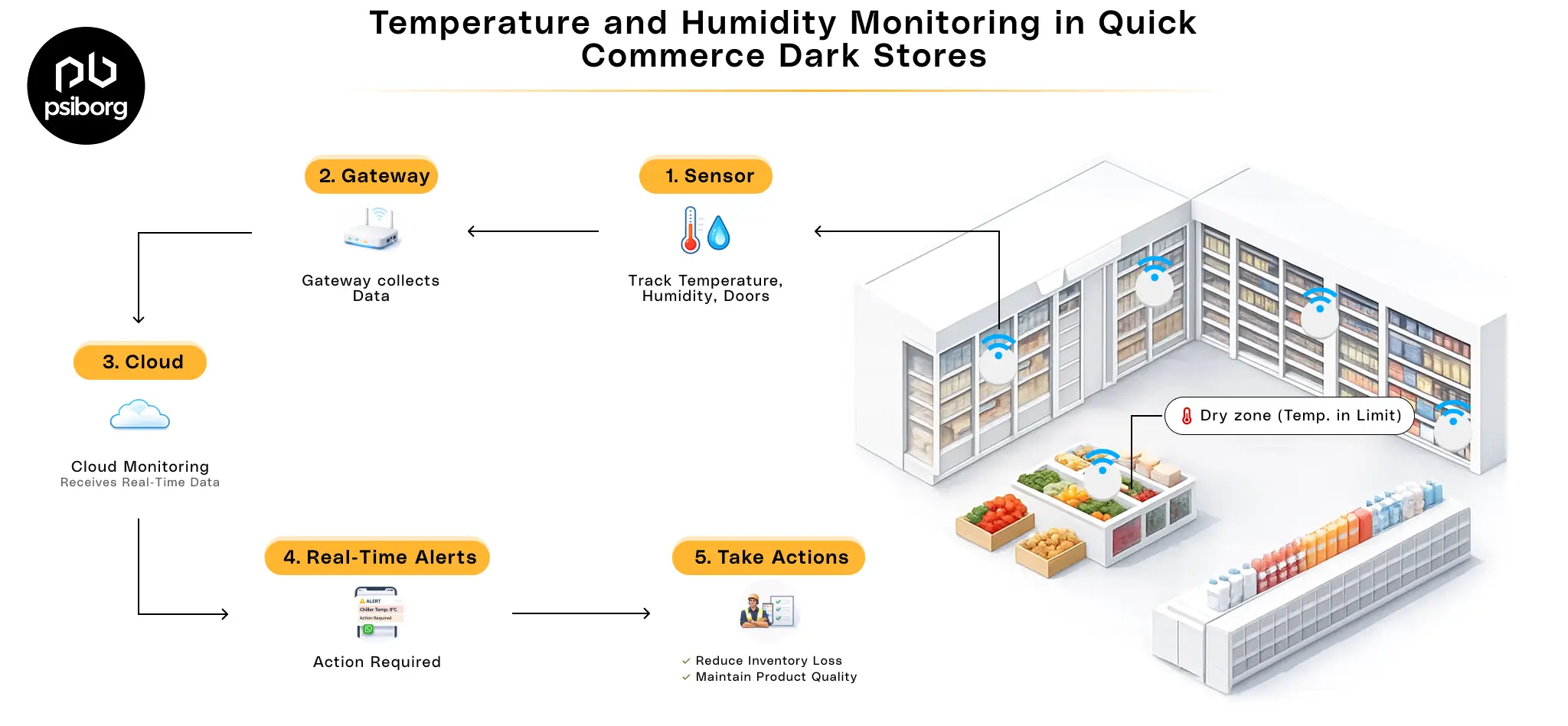
IoT-powered monitoring replaces periodic checks with always-on visibility across every storage zone in a dark store. Small industrial-grade sensors are placed inside ambient areas, chillers, freezers, and cold rooms to capture temperature and humidity data every few seconds.
Here’s how the system works in practice:
- Sensors log temperature and humidity every 1–5 minutes per zone, far beyond what any manual check schedule can match.
- Cloud dashboard displays all zone readings in real time, accessible from any device, anywhere, with no need to physically be in the store.
- Threshold breach in any zone → instant alert fires via WhatsApp, SMS, or app to the designated contact before spoilage begins.
- Door-open alerts trigger if a cold room door stays open beyond a set limit (e.g., 10 minutes), one of the most common and overlooked causes of temperature spikes.
- Power failure alerts activate the moment grid power drops, before temperatures even begin to rise, giving your team a critical response window.
- All data is securely stored in the cloud, making it accessible from anywhere and simplifying audit processes significantly.
Once IoT monitoring is in place, performance depends on what sits behind it. The real value comes from how well each component works together, especially in fast-moving dark store environments.
Also Read – Temperature & Humidity monitoring in Pharmaceutical Industries.
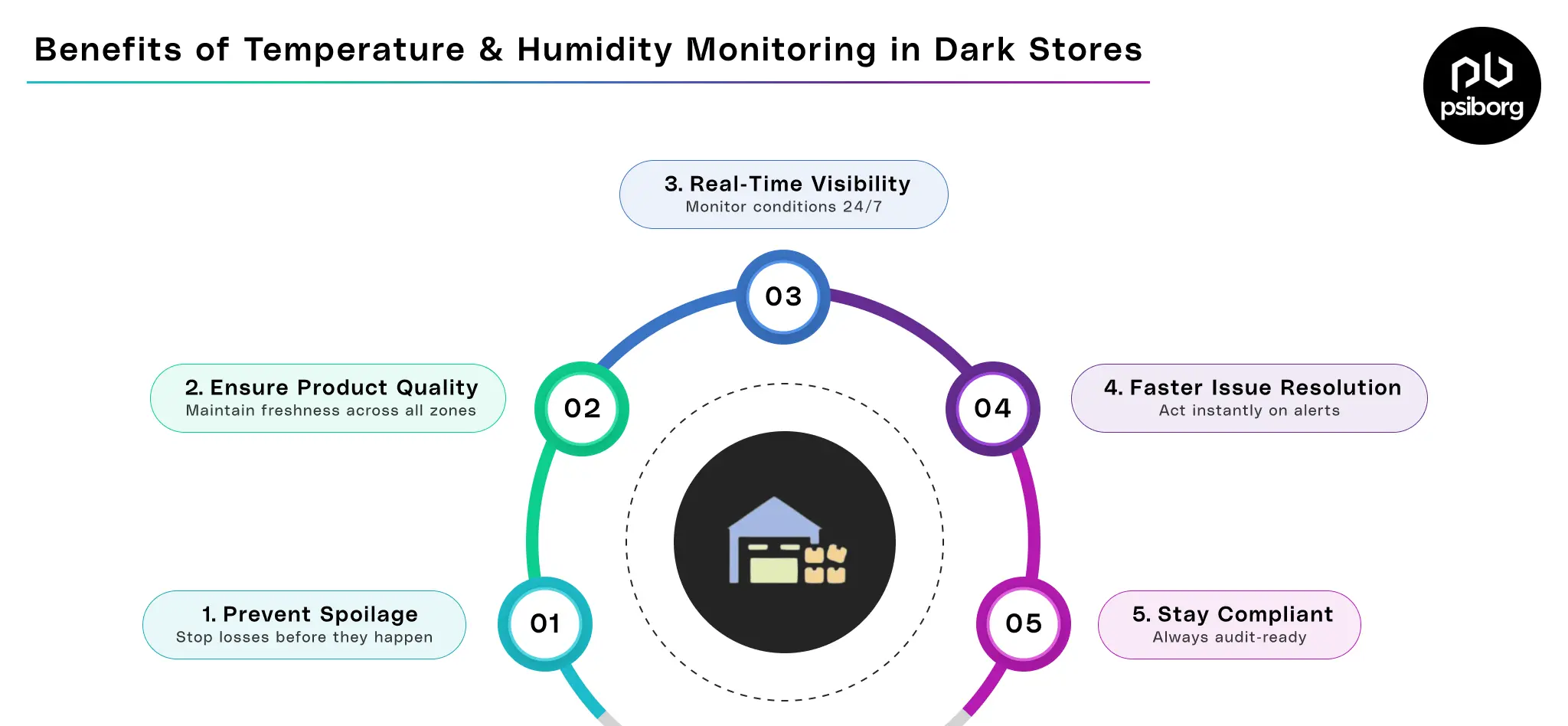
Features of a Reliable Temperature & Humidity Monitoring System
A reliable monitoring system does more than collect data; it detects risk early, drives fast action, and holds up under operational pressure. For quick commerce dark stores, the following capabilities are essential.
1. Alerts & Automation That Prevent Loss
Effective systems react the moment conditions drift from safe limits.
- Temperature breach alerts flag sudden spikes or slow drifts before exposure becomes unsafe
- WhatsApp and SMS alerts ensure the right teams are notified instantly—without relying on dashboards
- Real-time spoilage alerts factor in both severity and duration, helping teams stop compromised inventory from being dispatched
- Threshold-based alerts for cold rooms allow different rules for chillers, freezers, and ambient zones, reducing false alarms.
2. Analytics & Reporting That Drive Better Decisions
Visibility over time is what prevents repeat issues.
- Automated temperature history reports replace manual logs with audit-ready digital records.
- Historical insights help identify peak-risk periods, recurring failures, and cooling inefficiencies.
- Data-driven adjustments prevent overcooling and reduce energy costs without risking quality.
3. Location & Scale: Built for Dark Store Networks
Monitoring must stay consistent as operations grow.
- Multi-store temperature and humidity monitoring standardizes control across regions
- A centralized dashboard provides a single view of all dark stores, enabling quick comparisons and faster leadership decisions
4. Reliability & Operations That Don’t Fail Under Pressure
The highest risks often appear during disruptions.
- Power failure alerts warn teams instantly during outages or voltage drops
- Early visibility prevents silent temperature drift when refrigeration is most vulnerable
5. Accuracy, Security, and Ease of Use
A monitoring system only works if teams trust the data and can act on it instantly.
- Industrial-grade sensors deliver precise readings even in cold rooms, freezers, and high-humidity zones, reducing false alarms and missed risks.
- Temperature and humidity data are securely stored, with access defined by role, protecting sensitive information while supporting audits and compliance.
- Clear visuals and intuitive alerts help frontline teams respond fast, without complex training or data interpretation.
Also Read – How to monitor grain moisture remotely in warehouses?
Conclusion
Temperature & humidity monitoring in quick commerce dark stores is core to protecting inventory, compliance, and customer trust. Manual checks and piecemeal tools leave gaps that spoilage, power glitches, and demand surges exploit.
The best systems today use continuous sensing, alerts, analytics, and central visibility to turn risk into control.
PsiBorg develops and delivers these complete end-to-end IoT solutions tailored to your business needs. From sensor integration and hardware design to cloud-connected dashboards and real-time alerting, PsiBorg handles all layers of IoT deployment, hardware, firmware, connectivity, cloud, and user interfaces.
Whether you need multi-store monitoring, custom dashboard reporting, or integration with existing systems, PsiBorg’s full-stack approach ensures your dark stores stay efficient and compliant. With industry experience across asset tracking, environmental condition monitoring, and telematics, PsiBorg empowers businesses to reduce waste, improve uptime, and make data-driven decisions.
Partner with PsiBorg for custom IoT monitoring solutions built for quick commerce.