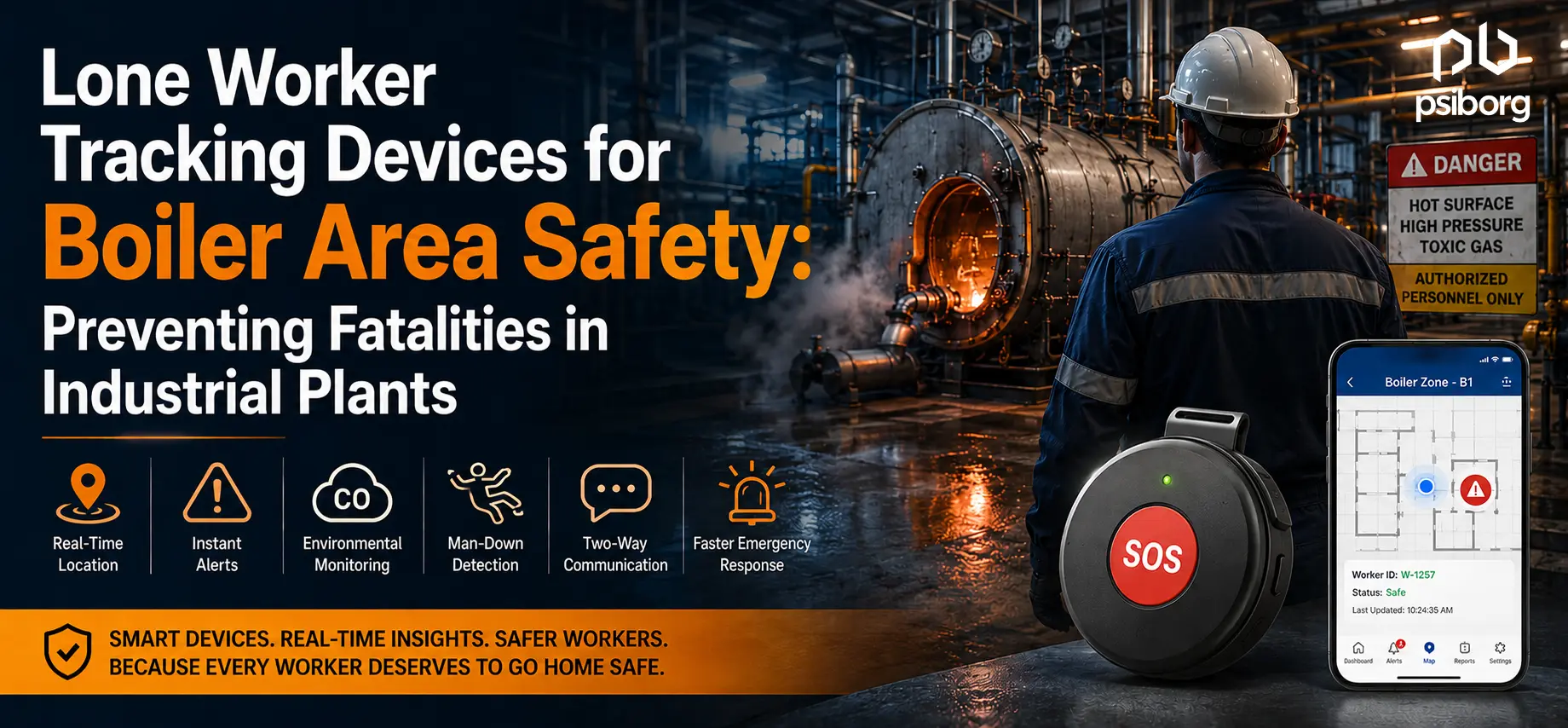
Boiler rooms and thermal power plant zones rank among industry’s most lethal environments high-pressure steam leaks, toxic gas exposure, oxygen-deficient confined spaces, and explosion risks are daily realities. Maintenance engineers and inspection technicians routinely work alone during night shifts, with limited visibility and no immediate backup.
Traditional PPE simply isn’t enough anymore. According to the International Labour Organization (ILO), nearly 3 million workers die annually from occupational accidents and work-related diseases globally. That’s why industries are rapidly adopting IoT-enabled lone worker safety devices, real-time worker tracking systems, and industrial lone worker monitoring.
This blog explores the unique hazards of boiler area environments and how modern employee tracking and lone worker monitoring systems are transforming safety outcomes from gas detection to SOS alerts to real-time location tracking.
Why Boiler Areas Are Considered High-Risk Zones?
Boiler areas are among the most hazardous zones in industrial facilities such as thermal power plants, petrochemical plants, paper mills, and manufacturing units. These environments include steam generation chambers, furnace sections, and pressure vessel rooms where workers are exposed to extreme heat, confined spaces, and high-pressure systems.
For lone workers handling inspections, maintenance, or shutdown operations, even a small malfunction can become life-threatening within seconds.
The biggest risks in boiler environments include:
- High-pressure steam explosions caused by tube failure or valve malfunction
- Extreme thermal radiation, with boiler surface temperatures often exceeding 300–600°C
- Toxic gas accumulation such as CO, SO₂, and NOₓ in enclosed spaces
- Confined space hazards with poor ventilation and limited escape routes
- High noise levels that prevent workers from hearing alarms or distress calls
- Night-shift lone working with minimal supervision during maintenance rounds
The recent Vedanta Power Plant Boiler Blast incident further highlighted how quickly boiler accidents can escalate in industrial settings.
Industrial Accidents Like the Vedanta Boiler Blast: A Preventable Tragedy
The recent Vedanta Power Plant Boiler Blast incident in Chhattisgarh became one of the deadliest industrial boiler accidents in recent years. A high-pressure steam tube explosion reportedly released superheated steam reaching nearly 600°C, killing 13–14 workers and injuring more than 20 during routine plant activity.
The tragedy raises a critical question:
Could real-time lone worker tracking and automated thermal alerts have reduced these fatalities?
While the exact operational failures remain under investigation, incidents like these often expose common safety limitations:
- No automated evacuation trigger for workers near the blast zone
- No individual distress signaling system
- Delayed visibility into worker locations after the explosion
- Slower rescue coordination during the emergency response phase
The Vedanta incident is not an isolated case. Boiler explosions and thermal accidents continue to cause industrial fatalities globally, particularly in high-risk sectors such as power generation, petrochemicals, and heavy manufacturing.
However, a real-time worker tracking system could potentially have:
- Identified workers present in the affected boiler zone instantly
- Triggered automated evacuation alerts through connected wearables
- Helped emergency teams locate injured workers faster using exact positioning data.
In high-temperature and confined operational zones, industries are increasingly shifting from manual supervision to intelligent lone worker monitoring systems that provide continuous visibility into worker safety.
How Lone Worker Tracking Helps in Boiler Area Safety?
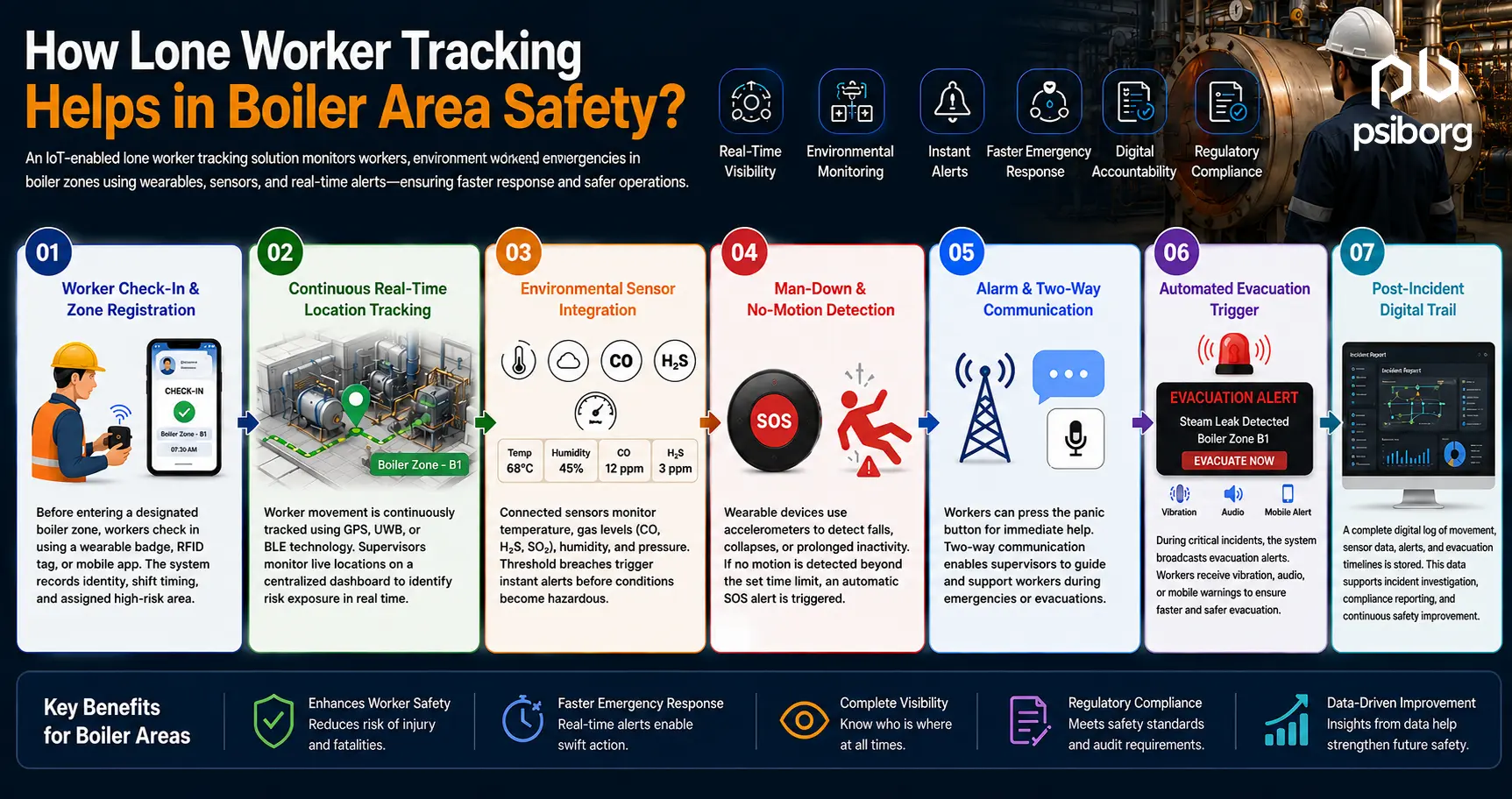
A lone worker tracking solution is an IoT-enabled safety system designed to monitor workers operating alone in hazardous industrial environments such as boiler rooms, furnace sections, pressure vessel areas, and confined maintenance zones. These systems combine wearable devices, indoor positioning technology, environmental sensors, and automated emergency alerts to improve worker safety and emergency response.
Here is how a modern lone worker tracking system typically operates inside a boiler zone:
Step 1: Worker Check-In & Zone Registration
Before entering a designated boiler zone, workers check in using a wearable badge, RFID tag, or mobile app. The system instantly creates a digital record of the worker’s identity, shift timing, and assigned high-risk area, ensuring accountability from the moment they enter the zone.
Step 2: Continuous Real-Time Location Tracking
Once inside the boiler area, the worker’s movement is continuously tracked using GPS, UWB (Ultra-Wideband), or BLE (Bluetooth Low Energy) technology. Safety supervisors can monitor live worker locations through a centralized dashboard, helping them identify workers near hazardous zones in real time.
Step 3: Environmental Sensor Integration
Connected sensors continuously monitor critical environmental conditions such as ambient temperature, gas concentration (CO, H₂S, SO₂), humidity, and pressure fluctuations. If readings cross predefined safety thresholds, the system automatically generates alerts before the situation escalates.
Step 4: Man-Down & No-Motion Detection
Wearable safety devices use accelerometer-based technology to detect falls, collapses, or prolonged inactivity. If a worker remains motionless beyond a configured time limit, the system automatically triggers an emergency SOS alert to the control room.
Step 5: Alarm & Two-Way Communication
In emergency situations, workers can manually activate a panic button on their wearable device to request immediate assistance. Advanced systems also enable two-way communication, allowing supervisors to guide workers during evacuation or rescue operations.
Step 6: Automated Evacuation Trigger
During critical incidents such as steam leaks, thermal spikes, or boiler pressure failures, the system can instantly broadcast evacuation alerts. Workers in affected zones receive vibration, audio, or mobile-based warnings, reducing evacuation delays during emergencies.
Step 7: Post-Incident Digital Trail
After an incident, the system stores a complete digital log of worker movement, environmental readings, emergency alerts, and evacuation timelines. This data helps industries improve incident investigation, compliance reporting, and future safety planning.
Also Read: Lone Worker Apps vs Hardware: Which Safety Solution is Better for Industrial Use?
Modern lone worker safety devices are designed not only to track worker location, but also to detect hazards, automate emergency response, and improve visibility across high-risk operational zones.
Key Features of Worker Safety Devices in High-Risk Zones
The effectiveness of a lone worker monitoring system depends on the technologies built into the device and how well they perform in hazardous industrial environments such as boiler rooms, furnace sections, and confined maintenance areas.
1. Real-Time GPS & Indoor Positioning
Modern worker safety tracking devices combine GPS for outdoor plant areas with UWB, BLE, or Wi-Fi RTLS for precise indoor positioning. In large boiler halls, this helps safety teams identify a worker’s exact location — often within ±30 cm accuracy — during emergencies.
2. High-Temperature & Thermal Hazard Sensing
Wearable-integrated or area-mounted sensors continuously monitor ambient heat exposure near boilers and steam pipelines. If temperatures rise beyond dangerous thresholds, workers receive automated alerts before prolonged exposure becomes life-threatening.
3. Gas Detection Integration
Advanced devices integrate multi-gas sensors capable of detecting:
- Carbon monoxide (CO)
- Hydrogen sulphide (H₂S)
- Sulphur dioxide (SO₂)
- Oxygen depletion
This is especially important for confined space safety monitoring inside steam generation and pressure vessel areas.
4. Man-Down & Motion Detection
Built-in 3-axis accelerometers detect falls, sudden collapse, or prolonged inactivity. These features are critical for lone workers operating during night shifts or isolated maintenance rounds.
5. Panic/SOS Button
Most industrial wearables include a one-touch emergency SOS button that instantly broadcasts worker location to the control room. Devices are typically designed for use with industrial gloves and harsh operational conditions.
6. Two-Way Communication
Push-to-talk (PTT) or voice-enabled communication helps reduce communication blackouts inside thick-walled boiler rooms where standard radio signals may fail.
7. Geofencing & Restricted Zone Alerts
Virtual safety boundaries can be created around ultra-high-risk zones such as active pressure vessels or high-temperature steam lines. The system automatically alerts supervisors if workers enter restricted areas.
8. Rugged Design & Long Battery Life
Industrial-grade devices are commonly:
- ATEX/IECEx certified
- IP67/IP68 rated
- Resistant to steam, dust, and water exposure
Most systems also support 12–24 hour battery life for full-shift monitoring.
9. Centralized Monitoring Dashboard
A lone worker monitoring dashboard provides safety teams with live worker visibility, zone-wise worker counts, alert history, and incident tracking from a single control interface.
10. Integration with Plant Safety Systems
Modern systems can integrate directly with SCADA, DCS, fire alarms, and industrial safety infrastructure through APIs, helping create a unified industrial boiler safety system across the facility.
In hazardous boiler environments, the biggest difference between a near miss and a fatal accident is often the speed of detection and emergency response.
Also Read: Best Lone Worker Safety Device for Remote & Isolated Workers (2026)
Preventing Industrial Fatalities Using Real-Time Tracking
Real-time lone worker tracking helps industries reduce emergency response delays, improve confined space safety, and strengthen accountability across hazardous boiler environments.
Key safety outcomes include:
- Faster medical response: Without tracking systems, locating a collapsed worker can take 15–30 minutes, often critical during heat stroke, steam burns, or gas exposure incidents. Real-time tracking enables emergency teams to identify worker location instantly and respond within minutes.
- Prevention of silent confined-space fatalities: Workers entering boiler drums, ash hoppers, or steam chests can be monitored through digital entry logs, periodic check-in alerts, and automatic escalation if no response is detected.
- Environmental pre-warning alerts: Integrated gas and heat sensors can provide workers with 30–120 seconds of evacuation time before conditions become life-threatening, making steam explosion safety measures more proactive.
- Better compliance and accountability: Digital audit trails support OSHA, ISO 45001, and Factory Inspectorate compliance while reducing employer liability during investigations.
- Improved behavioral safety: Real-time visibility encourages stronger adherence to PPE and hazardous area safety protocols.
As industrial facilities adopt smarter safety infrastructure, many are moving away from generic worker monitoring tools toward customized IoT-based safety ecosystems designed specifically for hazardous operational environments.
How PsiBorg Provides Custom IoT-Based Lone Worker Tracking Solutions for Boiler Safety?
PsiBorg approaches industrial safety from an engineering and systems-integration perspective rather than offering a one-size-fits-all tracking product. We at Psiborg focuses on designing custom IoT-based lone worker tracking solutions for hazardous environments such as boiler rooms, furnace sections, confined maintenance zones, and high-temperature manufacturing facilities.
Depending on operational requirements, PsiBorg typically helps industrial clients with:
- Custom wearable device configuration based on thermal thresholds, gas exposure limits, and restricted zone requirements.
- Indoor positioning system (IPS) deployment using UWB or BLE technology for GPS-denied boiler environments.
- Integration with existing plant systems such as SCADA, DCS, and ERP platforms.
- Real-time monitoring dashboards for safety supervisors and control room teams.
- Geofencing and automated hazard alert configuration for high-risk boiler zones.
- Compliance-ready audit trails for incident investigation and safety reporting.
If you’re evaluating lone worker tracking solutions for a boiler area or high-risk industrial zone, PsiBorg can assess your environment and develop a custom IoT-based lone worker safety solution as per your safety requirements.
Also Read: Check how PsiBorg has deployed Lone worker devices in Industries.
Conclusion
Boiler areas remain one of the most dangerous operational environments in industrial facilities due to extreme heat, steam pressure, confined spaces, and isolated working conditions. Traditional safety measures alone are no longer enough for modern industrial risk management. PsiBorg’s TrackLone is helping several industries keeping thier workers safe.
Real-time lone worker tracking systems help industries improve emergency response, strengthen confined space safety monitoring, reduce fatalities, and build a more proactive safety culture. As industrial plants continue adopting connected safety infrastructure, IoT-based worker protection systems are becoming a critical part of boiler area safety strategies.
Improve visibility, response time, and worker safety in high-risk boiler environments with custom IoT-based tracking solutions from Psiborg.