A rental C-arm, demo cardiac monitor, or trial infusion pump can leave a warehouse for a hospital hundreds of kilometres away, and the equipment company may lose visibility the moment it crosses the loading dock. Rental medical equipment tracking closes that gap.
Ownership remains with the company, but control becomes difficult. Hospitals lose up to 20% of mobile medical assets through misplacement or theft, with each item costing roughly $3,000 on average. Vendors face the same exposure across every site.
For equipment companies, this can mean replacement costs, delayed returns, and lost rental or demo revenue. GPS-based equipment tracking provides visibility throughout dispatch, transit, hospital deployment, and return. If you need to track equipment inside one hospital, see PsiBorg’s hospital asset tracking software guide.
What Is Rental Medical Equipment Tracking?
Rental medical equipment tracking is the use of GPS and cellular trackers to monitor medical devices sent out on rental, demo, trial or loan, from the moment they leave the warehouse until they come back. It is not the same as general “medical equipment tracking,” which can refer to different technologies depending on where the equipment is and who needs to monitor it. Indoor hospital tracking typically uses RTLS technologies such as BLE beacons, RFID, or Wi-Fi positioning to locate equipment such as infusion pumps, wheelchairs, or monitors within a hospital. This works well when the hospital controls the building infrastructure and tracking network.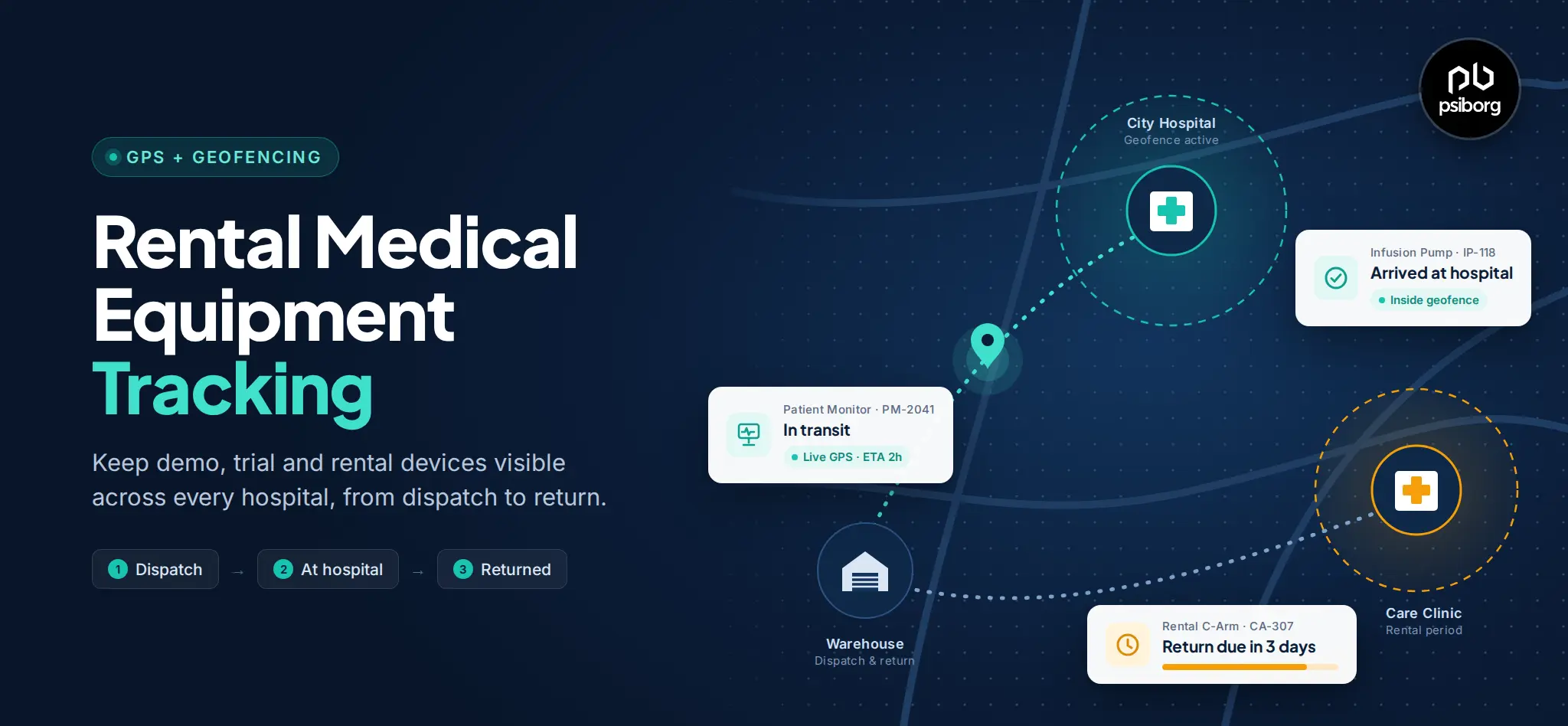
For medical equipment rental companies, manufacturers, distributors, and field service teams, however, the challenge is different. A demo cardiac monitor, rental C-arm, or trial infusion pump may move between hospitals, warehouses, service centres, and customer sites. These locations may be hundreds of kilometres apart and operate on networks the equipment owner does not control.
This is where GPS-based rental equipment tracking becomes more relevant. Instead of relying on fixed readers inside one facility, GPS and cellular connectivity can provide visibility while equipment is in transit, deployed at a customer site, awaiting collection, or returning to the warehouse.
In simple terms, indoor RTLS answers “Where is the equipment inside this building?” while rental equipment tracking answers “Where is our equipment, wherever it is?”
How It Differs from Hospital Asset Management
- Ownership and control are split. The equipment belongs to you; the building and network belong to the hospital.
- “Loss” means something different. In an indoor system, loss means misplaced somewhere in the building. Here, loss means the unit never comes back at all.
- Recovery isn’t a matter of walking the floor. It means contacting an external hospital’s biomed or purchasing department, sometimes weeks after the original point of contact has moved on.
- You’re managing many hospitals at once, not one facility with many rooms.
Why Rental Equipment Is Hard to Track After Dispatch
Talk to anyone running a demo or rental fleet and the same pattern comes up. Visibility ends the moment the courier or field rep signs the delivery confirmation. From there:
- Hospitals reassign or relocate rental and demo units internally without telling the vendor. A unit earmarked for cardiology quietly ends up in the ICU two days later.
- Rental, demo or trial periods extend past the agreed window with nothing flagging it.
- Multiple units are in the field simultaneously, across different hospitals, tracked (if at all) through spreadsheets, email threads, and follow-up phone calls.
- End-of-trial recovery becomes a manual chase: calling the original contact, who may no longer be reachable, to ask where the unit physically sits today.
None of this is a hospital operations failure. It’s a visibility failure on the equipment owner’s side, because nothing in the process generates a location signal once the equipment is out the door.
Indoor Hospital Tracking vs GPS Tracking for Rental Equipment
Comparison Factor | Indoor Hospital Tracking | Rental Equipment Tracking (GPS) |
Location Scope | Within one building | Across multiple external hospitals |
Network Dependency | Hospital Wi-Fi, BLE, or RFID readers | Independent GPS + cellular connectivity |
Primary Risk | Equipment misplaced within the facility | Equipment lost, delayed, or not returned after deployment |
Who Initiates Recovery | Hospital biomedical/facilities team | Equipment owner, vendor, distributor, or rental company |
Typical Technology | BLE beacons, RFID, Wi-Fi positioning | GPS/cellular trackers and geofencing |
Key Features of a Rental Medical Equipment Tracking System
A system built for rental and demo equipment that moves between external hospitals needs to do more than plot a dot on a map. The features below are what separate a purpose-built deployment tracking setup from a spreadsheet with a tracker bolted on.
Feature | What It Does |
Asset registration | Every unit gets a record (model, serial number, value, condition) before it leaves the warehouse. |
GPS/cellular hardware | Magnetic-mount or embedded trackers bound to a specific asset ID, reporting location independent of the hospital’s own network. |
In-transit visibility | Live location during dispatch and return legs, useful when a trial device is needed for a scheduled procedure. |
Geofencing & alerts | Automatic status changes on arrival/return, plus alerts if a unit leaves its designated hospital without a logged reason. |
Rental and demo period tracking | Elapsed time is measured against the agreed demo, trial, or rental period, with flags before deadlines are missed. |
Centralized dashboard | A single view across every hospital, department, and unit currently in the field, replacing spreadsheets and email threads. |
Tracker reuse | Trackers are unassigned from returned units and reassigned to the next outbound deployment, keeping hardware cost per deployment low. |
Deployment history & reporting | A timestamped, per-asset log for utilization analysis, insurance or loss claims, and demo-to-sale conversion tracking. |
Benefits of Rental Medical Equipment Tracking
The financial case is straightforward: a 300-bed hospital can lose an estimated $1–2 million a year to missing equipment alone, and rental and demo equipment providers carry a version of that same exposure across every hospital they’ve placed units in. Extending visibility past the loading dock changes several outcomes at once:
- Fewer units go permanently missing. Geofencing flags unexpected movement while a unit can still be traced, instead of after it has already been resold, redeployed elsewhere, or written off.
- Rental and demo revenue is protected. A unit sitting past its return date is flagged automatically, rather than discovered when a new customer needs that same model.
- Less manual chasing. Arrival and return are confirmed by geofence events, cutting down on follow-up calls to biomed or purchasing contacts who may have since changed roles.
- Higher utilization per tracker. Reusable trackers move from a returned unit straight to the next outbound deployment, so hardware cost is spread across many deployments rather than tied to one asset.
- A defensible audit trail. Timestamped dispatch, arrival, and return events support insurance or loss claims and give a factual basis for demo-to-sale conversion analysis.
- Less friction with hospital partners. Status comes from the tracker rather than repeated check-in calls to clinical or biomed staff, which keeps the vendor relationship low-maintenance for the hospital side.
How to Track Rental Medical Devices from Dispatch to Return
Every rental, demo or trial unit goes through the same four stages, from the moment it is boxed up to the moment it’s back in inventory and reassigned:
Before Dispatch: Set Up the Asset
- Register the equipment. Record each unit’s model, serial number, value and condition before it leaves the warehouse.
- Attach a GPS tracker. Bind a battery-powered tracker to the asset’s ID. Use a magnetic-mount or embedded tracker, depending on the equipment type.
- Log the deployment details. Enter the destination hospital, department, point of contact, deployment type (demo, trial, rental or loaner) and expected return date.
In Transit: Confirm It’s on the Way
- Dispatch and track the outbound journey. Once the shipment is marked out, the tracker starts reporting live location. This matters most when a trial device has to arrive before a scheduled procedure.
- Confirm arrival automatically. When the unit enters the geofence around the destination hospital, its status changes to “arrived,” with no confirmation call needed.
At the Hospital: Monitor the Rental Period
- Track the rental window. The system measures elapsed time against the agreed demo, trial or rental period and flags approaching deadlines before they’re missed.
- Get alerts for unexpected movement. If the unit leaves the hospital’s geofence without a logged reason, an alert fires. The cause could be a move to another facility, removal off-site or, in the worst case, theft.
Return: Close the Loop
- Track the return shipment. The return journey is monitored the same way as the outbound one.
- Close the record on arrival. When the unit re-enters the geofence at your warehouse or service centre, the deployment record closes automatically.
- Reassign the tracker. Unassign the tracker from the returned unit and attach it to the next outbound deployment, so one tracker serves many deployments.
How PsiBorg Helps You Track Rental Medical Equipment
Once a rental cardiac monitor, infusion pump, C-arm, or other medical device leaves your warehouse, keeping track of it can become difficult. The equipment may move between hospitals, customer sites, service centres, and warehouses, often outside your own network infrastructure.
This is where an IoT-based rental equipment tracking solution can help. PsiBorg does not provide equipment tracking as a managed service; instead, it designs and builds the technology that enables businesses to track their equipment.
A typical solution can combine GPS/cellular-enabled tracking hardware, embedded firmware, cloud connectivity, geofencing, and a centralized dashboard. The tracker can be assigned to an individual equipment unit, while the dashboard can provide location and deployment information across multiple assets.
What a Custom Tracking Solution Covers
The solution can be designed to support the complete rental lifecycle:
- Dispatch: Monitor equipment movement after it leaves the warehouse.
- Arrival: Use geofencing to identify when it reaches the designated hospital.
- Rental period: Maintain location visibility while the equipment is at the customer site.
- Return: Monitor the journey back to the warehouse or next deployment location.
Instead of building a tracking process around spreadsheets and manual calls, companies can develop a purpose-built IoT based asset tracking and monitoring system around their equipment, workflows, and operational requirements.
Explore medical equipment tracking software to understand how such a solution can be built.
Build the Right GPS Tracking Solution for Your Rental Fleet
Rental, demo and trial equipment deployed across hospitals needs more than indoor asset tracking. A GPS and cellular-based IoT solution can provide visibility from warehouse dispatch and hospital arrival through the rental period and eventual return.
PsiBorg builds customized rental medical equipment tracking solutions combining tracking hardware, firmware, connectivity, geofencing, and dashboards to fit your operational requirements.
If you’re looking to reduce manual follow-ups and gain better visibility over your rental fleet, reach out to PsiBorg to discuss your tracking requirements.
Contact us to build a GPS tracking solution for your rental equipment.