What if every mile your vehicle drives could tell you exactly how to save fuel, improve safety, and grow profits, all in real time?
With the global vehicle tracking market projected to reach $6.56 billion by 2032, smart tracking isn’t just a luxury, it’s essential to improve efficiency and cut costs.
If your business depends on a fleet, from delivery trucks to service vans, knowing the top 10 must-have features in an IoT-enabled vehicle tracking device isn’t just smart, it’s strategic.
This blog discusses the top 10 features every modern device needs to help your business thrive.
Ready to optimize your fleet’s future? Let’s explore together!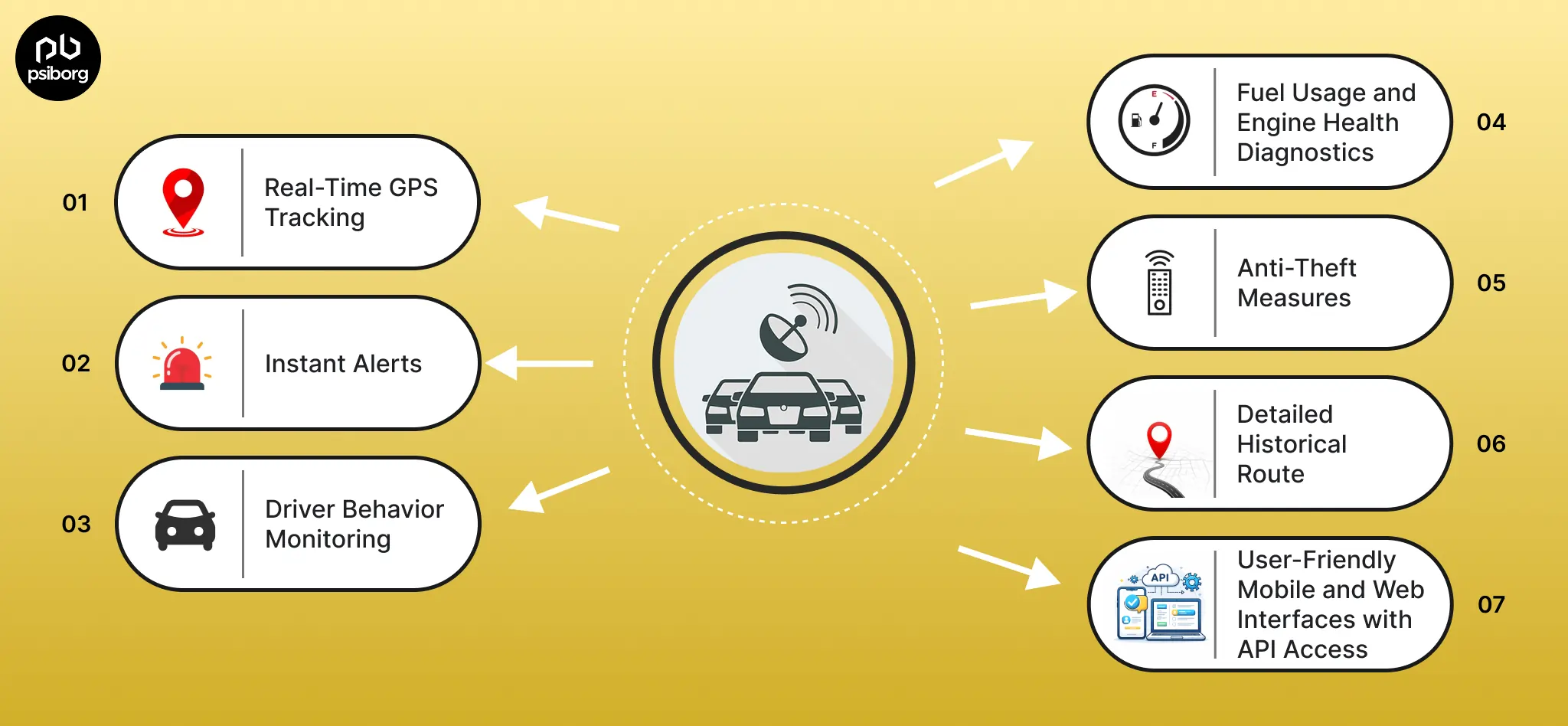
What is an IoT-Enabled Vehicle Tracking Device?
An IoT-enabled vehicle tracking device is a compact, rugged hardware unit installed in a vehicle that continuously collects vehicle and environment data, securely transmits it over cellular network, and feeds that data into cloud systems for real-time monitoring, analytics and action.
Unlike a basic GPS tracker that only reports location, an IoT vehicle tracker is a full telematics node, it senses, communicates, updates, and integrates with business systems.
Key characteristics of IoT-based vehicle tracking device are:
- Real-Time Data Transmission: Uses cellular or satellite networks (4G/5G) for constant updates on vehicle location, speed, and status.
- Sensor Integration: Includes various sensors to monitor engine health, fuel levels, tire pressure, and driver behavior.
- Two-Way Communication: Enables remote commands such as engine immobilization or alerts for maintenance needs.
- Cloud-Based Data Management: Data collected is securely stored and analyzed on cloud platforms, allowing easy access through web or mobile apps.
Let’s have a look at exactly what smart trackers do for your bottom line, and how they turn vague problems into measurable wins?
Why Do Businesses Need Smart IoT Vehicle Tracking Devices?
Businesses with vehicle fleets face challenges in managing costs, productivity, and customer satisfaction. Smart IoT vehicle tracking devices provide the advanced tools needed to overcome these challenges by converting raw data into actionable insights.
Some of the key business drivers are:
- Immediate operational visibility: Know vehicle location, status and route adherence in real time to reduce delays and improve dispatch decisions.
- Lower running costs: Monitor idling, route inefficiencies and harsh driving to cut fuel and maintenance spend.
- Predictable uptime: Remote diagnostics and sensor streams let you schedule maintenance before failures happen.
- Theft and misuse prevention: Geofences, tamper alerts and remote immobilisation stop unauthorised use and speed recovery.
- Safer workforce: Driver scoring and event alerts reduce accidents and insurance claims through targeted coaching.
- Actionable integrations: APIs push telematics data into TMS, ERP and payroll systems so decisions are automated, not manual.
Now that we understand why smart IoT vehicle tracking matters, let’s explore the key features that make these devices indispensable tools for your business.
Top 10 Must-Have Features in an IoT-Enabled Vehicle Tracking Device
Building on why businesses rely on smart vehicle tracking and monitoring systems, here are the essential features that make IoT-enabled devices truly impactful. Each feature is backed by current tech standards and proven business utility.
Here are some must have features that defines a smart IoT-enabled vehicle tracking device:
1. Real-Time GPS Tracking with Multi-Constellation Support
Today’s vehicle trackers must utilize multiple satellite systems to provide meter-level accuracy. This multi-constellation approach ensures reliable and precise location data even in challenging environments like urban canyons or dense forests, critical for effective route management and asset security.
2. Geofencing and Instant Alerts
Geofencing allows businesses to define specific geographic boundaries. The device automatically triggers instant notifications when vehicles enter or exit these zones, helping prevent unauthorized use and enabling compliance with service areas. Such real-time alerts improve operational control and immediate response capabilities.
3. Comprehensive Driver Behavior Monitoring
Advanced trackers record critical patterns including harsh braking, acceleration, speeding, idling, and sharp turns, while offering driver scorecards and coaching suggestions. This feature directly correlates to improved safety, reduced accident rates, lower wear and tear, and significant fuel savings.
4. Fuel Usage and Engine Health Diagnostics via OBD-II/CAN Bus
Integrated with onboard diagnostics ports (OBD-II) or CAN bus, trackers monitor fuel efficiency, engine temperature, battery health, and diagnostic trouble codes. Early warnings enable proactive maintenance, minimizing breakdown risks and vehicle downtime that can cost thousands.
5. Remote Immobilization and Anti-Theft Measures
Device-controlled remote engine cut-off combined with tamper alerts and panic buttons provides a robust theft deterrent. This feature empowers fleet managers to take immediate action if unauthorized vehicle movement is detected, securing valuable assets.
6. Multi-Network Communication (4G LTE, Satellite)
Diverse connectivity options guarantee uninterrupted data transmission from urban centers to remote locations, balancing cost and power efficiency. Satellite backup coverage ensures persistent tracking even where cellular networks fail, critical for high-value or long-haul fleet assets.
7. Rigid Hardware with Extended Battery Life
Devices are engineered for extreme environments, rated IP65 or higher for dust and water resistance, and equipped with batteries lasting up to several months under varied ping intervals. This durability ensures reliability and lowers total cost of ownership by reducing maintenance needs and device replacements.
8. Detailed Historical Route Playback and Analytics
Storing granular trip data enables businesses to review routes for operational efficiency, regulatory compliance, and dispute resolution. This playback functionality supports audits and continuous improvement initiatives through rich data insights.
9. User-Friendly Mobile and Web Interfaces with API Access
Real-time dashboards with customizable alerts empower fleet managers and drivers with instant visibility and control. Open APIs facilitate seamless integration with enterprise systems like CRM, ERP, and dispatch platforms, unlocking automation and scalability benefits.
10. AI-Driven Predictive Analytics and Optimization
Beyond raw data, AI-powered analytics interpret patterns to forecast predictive maintenance needs, recommend fuel-saving routes, and identify inefficiencies. This transforms tracking systems into smart decision-support tools driving measurable cost savings and operational excellence.
Also Read: Start Your Business Fast with White Label GPS Tracking Software and Device Integration
Now that we’ve explored the must-have features, let’s understand the precise mechanics of how an IoT vehicle tracking system functions to deliver real-time, actionable insights.
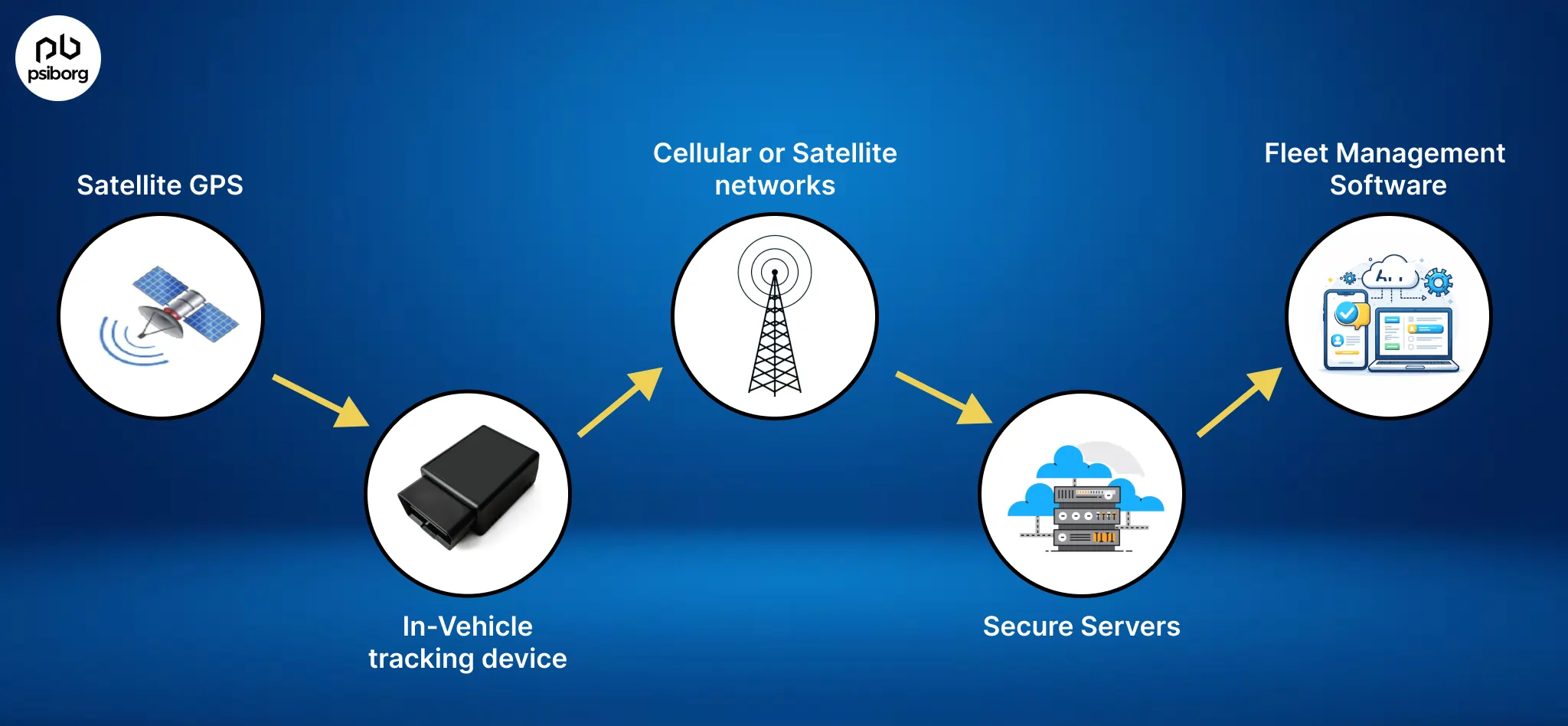
How Does the IoT Vehicle Tracking System Work?
An IoT vehicle tracking system integrates hardware, communication networks, and cloud software to provide continuous, precise monitoring and management of vehicles. Here’s a breakdown:
1. Device Installation and Sensor Integration
- Physical trackers are installed in vehicles, usually connected via OBD-II ports or hardwired to the electrical system.
- Embedded sensors like temperature , humidity , Fuel sensor , and other peripherals , which communicate to the main device using BLE collect diverse data, location, engine performance, fuel levels, and more.
2. Multi-Constellation GNSS for Precise Location
- The device utilizes multiple satellite systems like GPS for highly accurate positioning under various conditions.
3. Data Transmission via Multiple Networks
- Collected data is sent in real-time through cellular (4G/5G), Low Power Wide Area Networks (LPWAN), or satellite networks for remote areas.
- Multi-network capability ensures uninterrupted communication regardless of location.
4. Cloud-Based Data Storage and Processing
- Data streams are securely transmitted to cloud servers, where powerful analytics and AI algorithms process them instantly.
- This enables predictive maintenance alerts, routing optimizations, and driver behavior analyses.
5. User Interaction via Dashboards and Mobile Apps
- Fleet managers access real-time dashboards that provide live maps, alerts, and detailed reports.
- Customizable notifications allow quick responses to geofence breaches, engine alerts, or safety concerns.
Also Read: IoT Based Automatic Vehicle Accident Detection And Rescue System
With a clear understanding of how IoT vehicle tracking systems work, let’s examine the diverse real-world applications that demonstrate their critical value across industries.
Use Cases of Vehicle Tracking Device
IoT-enabled vehicle tracking devices serve multiple business functions across sectors, driving efficiency, security, and customer satisfaction:
- Fleet Management and Logistics
- Tracks location, optimizes routes, and monitors driver performance.
- Example: A courier company will be able to use tracking data to reduce delivery times and minimize fuel consumption through optimized routing.
- Theft Prevention and Asset Security
- Real-time alerts and remote immobilization safeguard vehicles against theft.
- Example: Construction firms can protect expensive machinery from unauthorized use on-site by geofencing and disabling stolen equipment remotely.
- Driver Safety and Compliance Monitoring
- Monitors behavior, driving hours, and compliance with safety regulations.
- Example: A transportation company can reduce accidents by coaching drivers based on behavior alerts and ensuring hours-of-service compliance.
- Fuel Monitoring and Cost Control
- Detects fuel theft and promotes efficient consumption via analytic reporting.
- Example: A mining operation will be able to identify and stop fuel siphoning from trucks, saving thousands annually.
- Preventive Maintenance and Downtime Reduction
- Tracks engine health and schedules predictive maintenance to avoid breakdowns.
- Example: A delivery fleet can decrease unscheduled maintenance using tracker alerts for vehicle diagnostics.
- Customer Service Enhancement
- Provides accurate ETAs and condition monitoring for deliveries or transport.
- Example: An e-commerce company can improve customer satisfaction by offering live tracking and timely delivery notifications.
Summing Up,
IoT-enabled vehicle tracking devices are revolutionizing fleet management by offering precise real-time insights, enhancing security, improving driver safety, and enabling predictive maintenance.
These devices provide businesses with actionable data to reduce costs, increase efficiency, and boost customer satisfaction. As fleets grow increasingly complex, using advanced IoT solutions becomes essential for staying competitive and agile.
Partner with PsiBorg, an IoT product development company, to transform how you manage your fleet with our fully integrated telematics and fleet management solutions combining state-of-the-art hardware and intelligent software.
Our custom vehicle tracking systems are tailored to your unique operational needs, ensuring seamless connectivity, data-driven decision-making, and strong security across your entire fleet.
Get in touch with PsiBorg today, and take the first step towards smarter, safer, and more profitable fleet management.