On a busy farm, missing one early sign of illness can cost you an entire herd’s productivity. That’s where IoT-powered cattle health monitoring is changing how you manage livestock. With sensors tracking temperature, movement, and behaviour in real time, farms can detect health issues earlier and reduce losses, driving better productivity and profitability.
In fact, the global livestock monitoring market is projected to reach $2.5 billion by 2028, highlighting rapid adoption across farms.
But here’s the key: choosing between SIM, BLE, and LoRa determines how effectively your solution performs, scales, and delivers value.
Why Technology Selection Matters in Cattle Health Monitoring?
In cattle health monitoring system, the sensor is only one part of the solution. The real value comes from how reliably that data moves from the animal to your platform, how often it updates, and how much it costs to maintain at scale.
Research on livestock monitoring systems shows that technologies such as LoRaWAN, BLE, and cellular each solve different farm problems, depending on range, power use, infrastructure, and terrain.
For businesses building cattle monitoring products or deploying them across farms, this is a strategic decision. The wrong technology can create blind spots in animal health data, increase battery replacement cycles, raise recurring connectivity costs, or make expansion difficult once the number of animals or farm sites grows.
Here’s the reason why this decision matters in real farm conditions:
What you need to manage | Why technology selection matters |
Early illness alerts | If data does not transmit consistently, changes in temperature, movement, or activity may be detected too late. |
Large farm coverage | Wide grazing areas need longer-range communication; short-range systems can leave uncovered zones. |
Battery life | High-power connectivity increases maintenance effort because devices need charging or replacement more often. BLE and LoRa are often chosen partly for lower power demand. |
Total cost of ownership | Some options look cheaper at device level but become expensive after gateway deployment, SIM plans, or servicing across many animals. |
Data reliability in rural areas | Remote farms may have weak cellular coverage, making gateway-based or LPWAN designs more practical. |
Now that you know why connectivity choice matters so much, the next step is to understand what each technology actually does in a cattle health monitoring system.
Overview of Core Technologies Used in Cattle Health Monitoring
Cattle health monitoring systems follow a simple flow: sensors collect data, connectivity transmits it, and platforms turn it into actionable insights. What really differentiates these systems is the communication layer, as SIM, BLE, and LoRa each solve different challenges around range, cost, and power.
Now, let’s start by understanding the most direct connectivity options used in livestock monitoring.
What is SIM-Based (Cellular) Tracking?
SIM-based tracking uses a cellular module inside the cattle wearable to send data straight to the cloud over 4G, 5G, LTE-M, or NB-IoT networks. That means the device does not need a nearby BLE reader or LoRa gateway to move data off the animal. This makes it especially useful for large outdoor farms, moving herds, and multi-location operations where direct connectivity matters.
Where It Helps You | What You Should Consider |
Sends data directly from the animal to the cloud (no gateway needed) | Uses more battery compared to BLE or LoRa |
Works well for large farms and outdoor grazing areas | Requires ongoing SIM and data plan costs |
Allows you to track cattle across multiple locations easily | Depends on the strength of cellular network in rural areas |
If you are monitoring cattle within a barn, shed, or other controlled area, a short-range and low-power option often makes more sense than cellular.
What is BLE (Bluetooth Low Energy) Tracking?
BLE, or Bluetooth Low Energy, is a short-range wireless technology that sends data from a cattle tag or collar to a nearby gateway, reader, or mobile device. In livestock use, it usually works best when animals stay within a limited area, such as dairy barns, feeding zones, or holding pens.
BLE is designed for short-distance communication, with practical livestock range often around 30–50 metres, though barriers and tag position can reduce that in real conditions.
Where It Helps You | What You Should Consider |
Uses very low power, so devices last longer on battery | Limited range compared to LoRa or SIM |
Lower connectivity cost at the device level | Requires nearby gateways or readers |
Works well in barns, sheds, and controlled farm areas | Signal can be affected by walls, metal, animal movement, and device placement |
Also Read: What is a Bluetooth Low Energy (BLE) Beacon and How Does It Work?
For farms spread across large open areas, you need a connectivity option that goes beyond short-range limits and does not depend entirely on cellular coverage.
What is LoRa (Long Range RF) Tracking?
LoRa (Long Range) is a low-power wireless technology designed to transmit small amounts of data over long distances. In livestock monitoring using IoT, sensors send data to a LoRa gateway, which then forwards it to the cloud. Depending on terrain and obstacles, LoRa can cover 500 metres to several kilometres, making it well-suited for large farms and grazing areas.
It is widely used in agriculture because it balances coverage and battery efficiency, allowing devices to run for months or even years on a single battery.
Where It Helps You | What You Should Consider |
Covers long distances across farms with fewer gateways | Requires LoRa gateways and initial setup |
Uses very low power, extending device battery life | Not ideal for high-frequency, real-time data transmission |
Works well in rural or low-connectivity areas | Performance depends on terrain and gateway placement |
Also Read: Why Do You Need LoRa Sensors for Long Range Networks?
Now that each technology is clear on its own, the next step is to compare them side by side to see which one actually fits your farm environment, monitoring goals, and budget.
SIM vs BLE vs LoRa: Which Connectivity Option Fits Your Cattle Monitoring Needs Best?
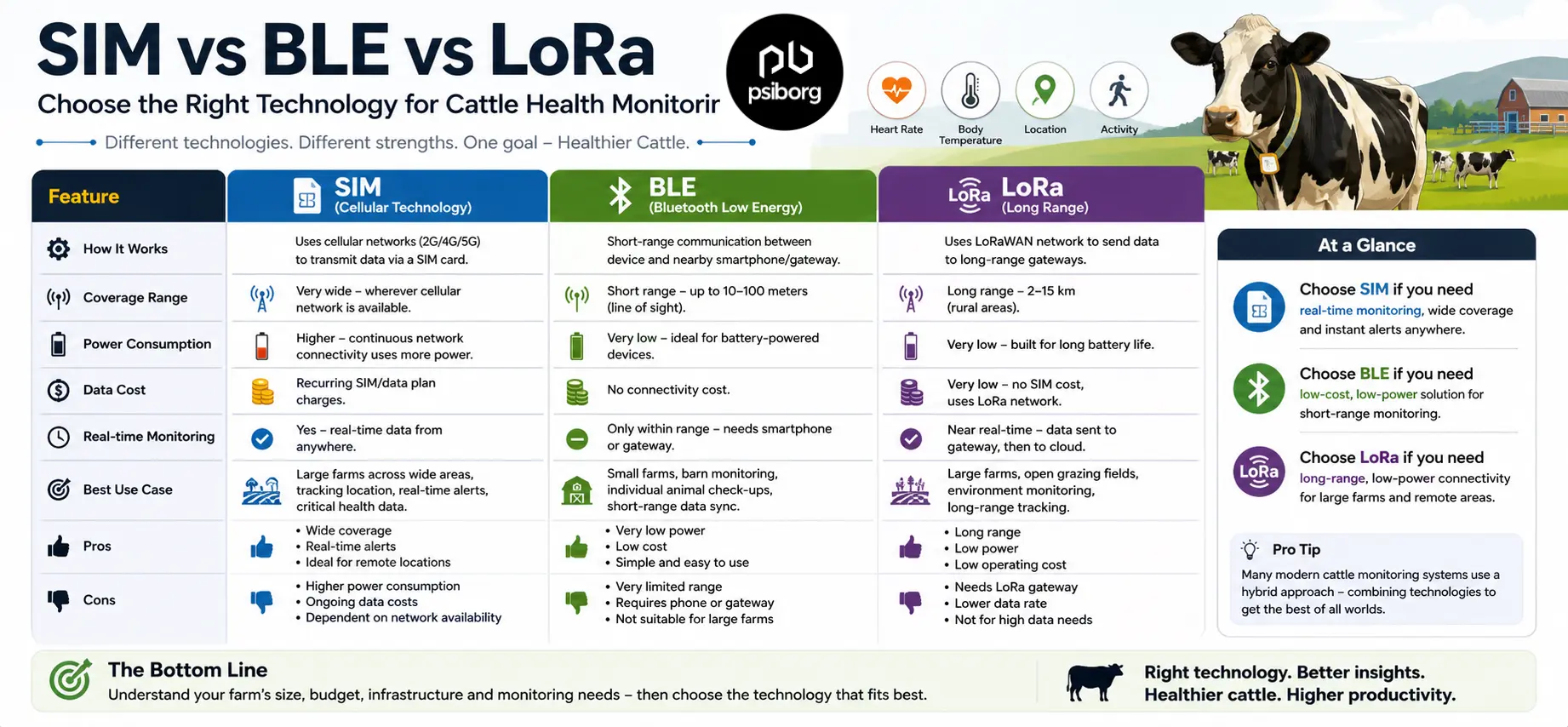
Each of these technologies supports cattle health monitoring in a very different way. SIM offers direct cloud connectivity and easier deployment, BLE works best in short-range controlled spaces, and LoRa is designed for long-range, low-power farm-wide coverage. So, the right choice depends less on which technology is “better” and more on your farm size, animal movement, infrastructure, and data needs.
So, here’s a quick comparison between all three technologies for cattle monitoring needs:
Parameter | SIM (Cellular – 4G LTE) | BLE (Bluetooth Low Energy) | LoRa (Long Range RF) |
Working Principle | Direct communication via cellular network | Devices send data to nearby BLE gateways | Devices send data to LoRa gateway |
Coverage per Gateway | Not required (uses telecom towers) | ~50 meters per gateway | ~500 meters |
Infrastructure Requirement | No additional infrastructure | Multiple BLE gateways required | LoRa gateway required |
Data Transmission Frequency | Configurable (e.g., every 1 hour) + real-time alerts | Configurable ( Higher frequency than LoRa) | Configurable (low frequency preferred) |
Real-time Alerts | Yes (instant via cellular) | Only if device is within gateway range | Only if device is within gateway range |
Battery Life | Low (30–45 days typical) – | High (1-2 years ) | Very high (1–3 years possible) |
Power Source | Rechargeable battery | non-rechargeable battery | non-rechargeable battery |
Recurring Cost | ₹30–₹50/device/month (M2M SIM) + SMS cost | No SIM cost , Gateway can be connected to WiFi | No SIM cost |
Gateway Cost | Not required | ₹6,000–₹7,000 per gateway | ₹30,000+ per gateway |
Scalability | High (no infra dependency) | Limited (gateway density increases) | Moderate to high |
Deployment Complexity | Very easy (plug & play) | Medium (gateway placement critical) | Medium (gateway setup + planning) |
Coverage Dependency | Depends on cellular network availability | Limited to installed gateways | Independent of telecom; needs LoRa infra |
Use Case Fit | Large/open farms, distributed livestock | Small farms (<500 m area) | Medium to large farms (clustered livestock) |
Blind Spots Risk | None (if network available) | High (needs min. 3 gateways for reliability) | Low (better penetration than BLE) |
Data Reliability | High | Medium (signal drops possible) | High (robust long-range communication) |
Latency | Low | Low (within range) | Medium (duty cycle limitations) |
Interference Sensitivity | Medium (network congestion) | High (2.4 GHz interference) | Low (sub-GHz frequency advantage) |
A side-by-side comparison shows how these technologies differ, but the best choice still depends on how your farm operates in the real world.
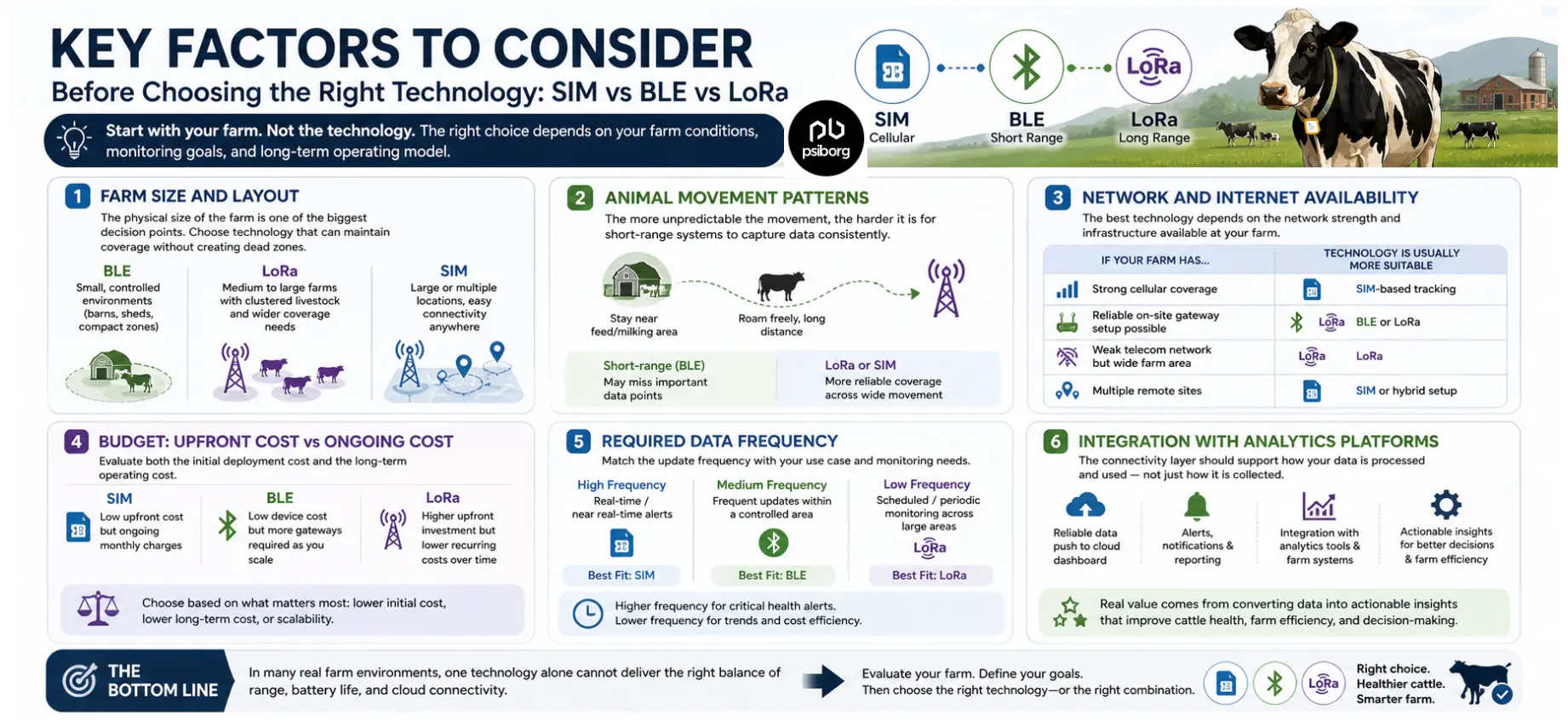
Key Factors to Consider Before Choosing the Technology
Choosing between SIM, BLE, and LoRa should not start with the technology itself. It should start with your farm conditions, monitoring goals, and long-term operating model. A solution that works well on a small dairy farm may become expensive, unreliable, or difficult to scale on a large open grazing site.
Below are the factors that matter most before you decide.
1. Farm Size and Layout
The physical size of the farm is one of the biggest decision points. If cattle stay within barns, sheds, or compact zones, short-range communication can work well. But if animals move across wide open land, you need a technology that can maintain coverage without creating too many dead zones.
In simple terms, BLE works well for small, controlled farm environments where cattle stay within a limited area, while LoRa is better suited for medium to large farms with clustered livestock and wider coverage needs.
For farms spread across large or multiple locations, SIM-based tracking is often easier to manage as it provides direct connectivity without relying on on-site infrastructure.
2. Animal Movement Patterns
It is not enough to know the farm size. You also need to know how cattle move within that space. Some herds stay near feed stations or milking areas, while others roam freely for long hours. The more unpredictable the movement, the more difficult it becomes for short-range systems to capture data consistently.
If animals move beyond the gateway range often, BLE may miss important data points. In such cases, LoRa or SIM gives more reliable coverage.
3. Network and Internet Availability
A technology may look strong on paper but fail in the field if the site lacks reliable network support. This is especially important in rural or remote livestock environments.
If your farm has… | Technology is usually more suitable |
Strong cellular coverage | SIM-based tracking |
Reliable on-site gateway setup possible | BLE or LoRa |
Weak telecom network but wide farm area | LoRa |
Multiple remote sites | SIM or hybrid setup |
4. Budget: Upfront Cost vs Ongoing Cost
Many businesses only compare device cost at the start, but that gives an incomplete picture. You need to evaluate both the initial deployment cost and the long-term operating cost.
SIM needs minimal setup but has ongoing monthly costs, while BLE keeps costs low but requires more gateways as you scale. LoRa involves higher upfront investment but offers lower recurring costs over time.
Your choice depends on whether you prioritise lower initial cost, lower long-term expenses, or scalability.
5. Required Data Frequency
Not every cattle monitoring system needs continuous real-time data. If your use case requires instant or near real-time alerts, SIM is usually the best fit. For frequent updates within a controlled space, BLE works well, while LoRa is more efficient for scheduled or periodic monitoring across large areas.
In simple terms, choose higher-frequency transmission for critical health alerts, and lower-frequency setups if your focus is on long-term trends and cost efficiency.
6. Integration with Analytics Platforms
The connectivity layer should support how your data is processed and used, not just how it is collected. You need to ensure it can reliably push data to your cloud dashboard, support alerts and reporting, and integrate with analytics tools or farm management systems.
This matters because real value comes from converting data into actionable insights that improve cattle health, farm efficiency, and decision-making.
In many real farm environments, one technology alone cannot deliver the right balance of range, battery life, and cloud connectivity.
Why Hybrid Connectivity Is Becoming the Smarter Choice for Livestock Monitoring?
A hybrid approach combines the strengths of multiple technologies instead of forcing one network to handle every task. In cattle health monitoring, this usually means using BLE for short-range sensing, LoRa for farm-wide data transfer, and cellular SIM for cloud sync or remote access.
Multi-layer systems are more practical because animal data is collected in different conditions, from barns and feed zones to open grazing areas.
Here’s how it works in practice:
- BLE: Collects data from nearby sensors in barns or controlled areas
- LoRa: Transfers data across the farm over long distances with low power
- SIM (Cellular): Syncs gateway data to the cloud for alerts, dashboards, and remote access.
This model works better because it reduces battery drain by limiting continuous cellular use, helping devices last longer. It also improves farm coverage by combining short- and long-range communication without heavy infrastructure.
Once the connectivity model is right, the real benefit starts to show where it matters most, animal health, productivity, and day-to-day farm decisions.
How the Right Connectivity Choice Leads to Better Cattle Health and Farm Performance
The right technology ensures health data is captured and delivered consistently, without delays or gaps. This directly improves how quickly you detect issues and take action, which is critical in large or distributed farm environments.
Here’s what it helps you achieve
- Earlier disease detection: Identifies changes in temperature, activity, or behaviour before visible symptoms
- Better behaviour monitoring: Tracks movement, feeding, and rumination patterns more accurately
- Fewer missed alerts: Reduces blind spots caused by poor connectivity or range limits
- Improved productivity: Supports better milk yield tracking and performance insights
- Data-driven decisions: Enables more accurate herd management and timely interventions.
Even with clear options and comparisons, many businesses still make decisions that lead to higher costs or poor system performance.
Common Mistakes to Avoid When Choosing IoT Technology for Cattle Monitoring
Choosing the wrong connectivity often leads to data gaps, higher maintenance, or limited scalability over time. These mistakes usually come from focusing on short-term convenience instead of long-term performance and farm conditions.
Some common mistakes that you should watchout for are:
- Choosing based only on upfront cost: Ignoring long-term operational and scaling expenses.
- Overlooking farm conditions: Not considering size, terrain, and cattle movement patterns.
- Ignoring scalability: Selecting a setup that cannot handle more animals or locations later.
- Underestimating connectivity gaps: Assuming network availability without field validation.
- Neglecting battery and maintenance impact: Choosing high-power solutions without planning replacements.
Once you understand the technology choices and common pitfalls, the next step is working with a partner who can turn that into a reliable, real-world solution.
How PsiBorg Helps You Build the Right Cattle Monitoring Solution?
PsiBorg delivers end-to-end IoT solutions tailored for livestock monitoring, combining hardware, connectivity, and software into one integrated system. Instead of a one-size-fits-all setup, PsiBorg designs solutions based on your farm size, cattle movement, and data requirements, ensuring the right mix of SIM, BLE, and LoRa for optimal performance.
PsiBorg helps you with:
- Custom device + connectivity design: Selects the right technology stack (SIM, BLE, LoRa, or hybrid) based on your use case.
- Integrated hardware and software: Builds sensor devices and connects them to a unified cloud platform.
- Hybrid architecture implementation: Combines BLE, LoRa, and SIM for better coverage, battery life, and cost efficiency.
- Scalable deployment: Designs systems that grow with your farm or business operations.
- Real-time IoT dashboards and alerts: Enables actionable insights for health monitoring and decision-making.
With PsiBorg, you don’t just deploy devices, you build a reliable, scalable, and data-backed cattle monitoring system aligned with your business goals.
Partner with PsiBorg to design and deploy the right IoT system for your needs.