
Poor yard visibility is an operational inconvenience and is also a major cost driver across modern logistics networks. According to the American Transportation Research Institute (ATRI), detention and waiting-time inefficiencies cost the U.S. for-hire trucking industry approximately $15.1 billion, with more than 135 million driver-hours lost due to delays.
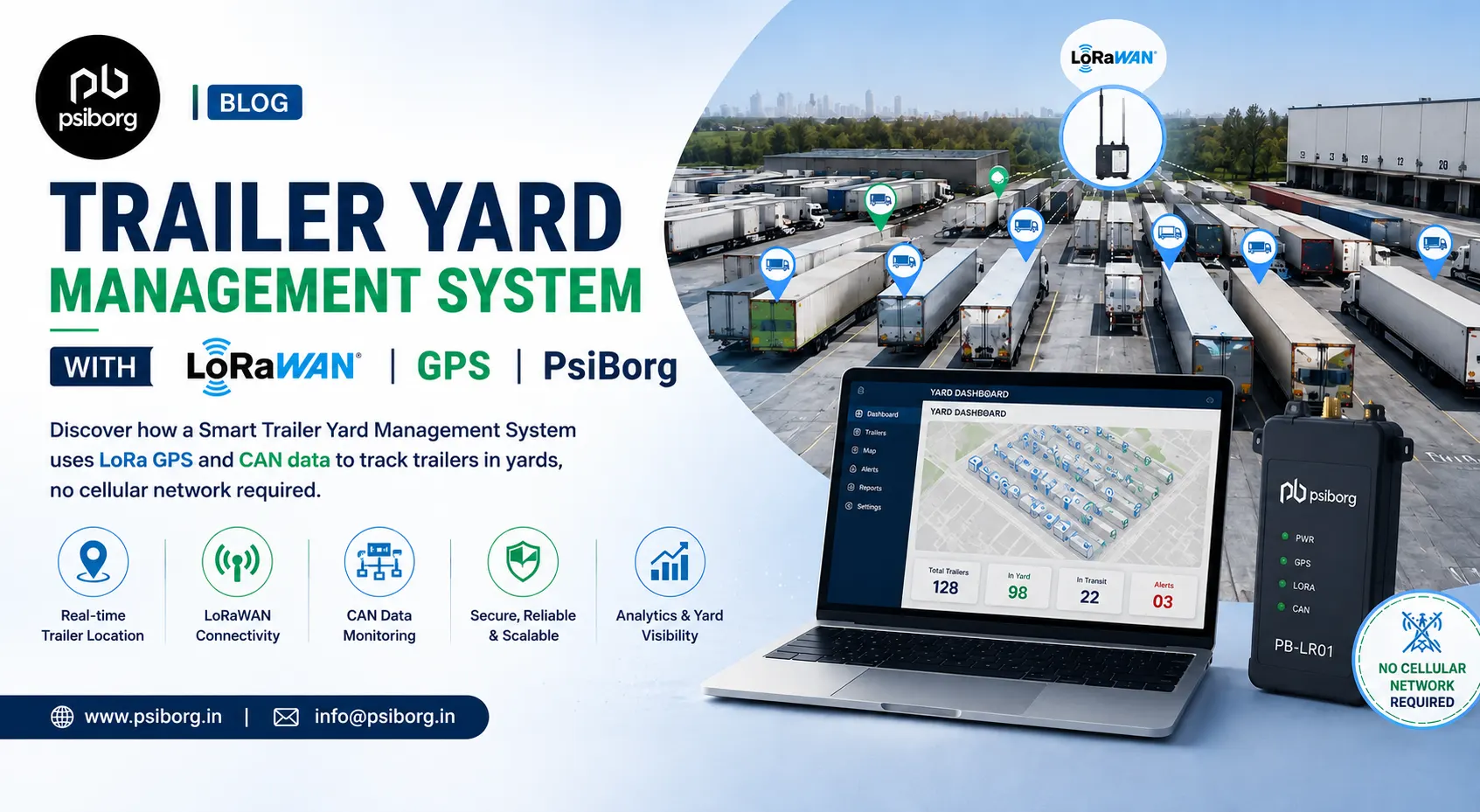
A Smart Trailer Yard Management System (Smart YMS) is an IoT-enabled platform that uses GPS devices installed on trailers and connected through gateways to provide real-time visibility into trailer location, movement, utilization, and health, without depending on public cellular networks.
In this article, we’ll explore how technologies such as LoRaWAN connectivity, CAN data integration, geo-fencing, trip alerts, and real-time trailer tracking are transforming yard operations across manufacturing, logistics, warehousing, and industrial facilities.
What Does a Traditional Yard Management System Look Like, And Why Does It Fall Short?
For many industrial facilities, yard management still depends on a combination of manual tracking methods and human coordination. Dispatchers use spreadsheets, whiteboards, paper pick-lists, and radio calls to track trailer movements across the yard.
While these processes may seem manageable on a small scale, they quickly become inefficient when hundreds of trailers are moving through large manufacturing plants, distribution centers, or industrial sites.
The biggest challenge is the lack of real-time visibility. When trailer locations are updated manually, information often becomes outdated, leading to delays, unnecessary trailer searches, and poor yard utilization.
Common limitations of traditional yard management systems include:
- No real-time trailer visibility, making it difficult to locate specific assets quickly.
- Misplaced or “lost” trailers within large yards, resulting in wasted spotter truck time.
- Manual data entry errors that create inaccuracies in yard inventories.
- Delayed decision-making because operators are working with outdated information.
- Heavy dependence on radio communication between gate staff, yard personnel, and dispatch teams.
- Limited scalability as trailer volumes and yard complexity increase.
The problem is even more pronounced in industrial environments. Many facilities, such as chemical plants, mining operations, and heavy manufacturing sites, experience unreliable cellular coverage or have operational restrictions that make public cellular networks impractical for continuous asset tracking. As a result, conventional logistics software often struggles to provide the visibility required for efficient yard operations.
This growing visibility gap is pushing industrial operators toward private LoRaWAN-based GPS tracking networks, which provide continuous trailer monitoring and location intelligence entirely within the facility’s own communication infrastructure.
How Does a Smart Trailer Yard Management System Actually Work?
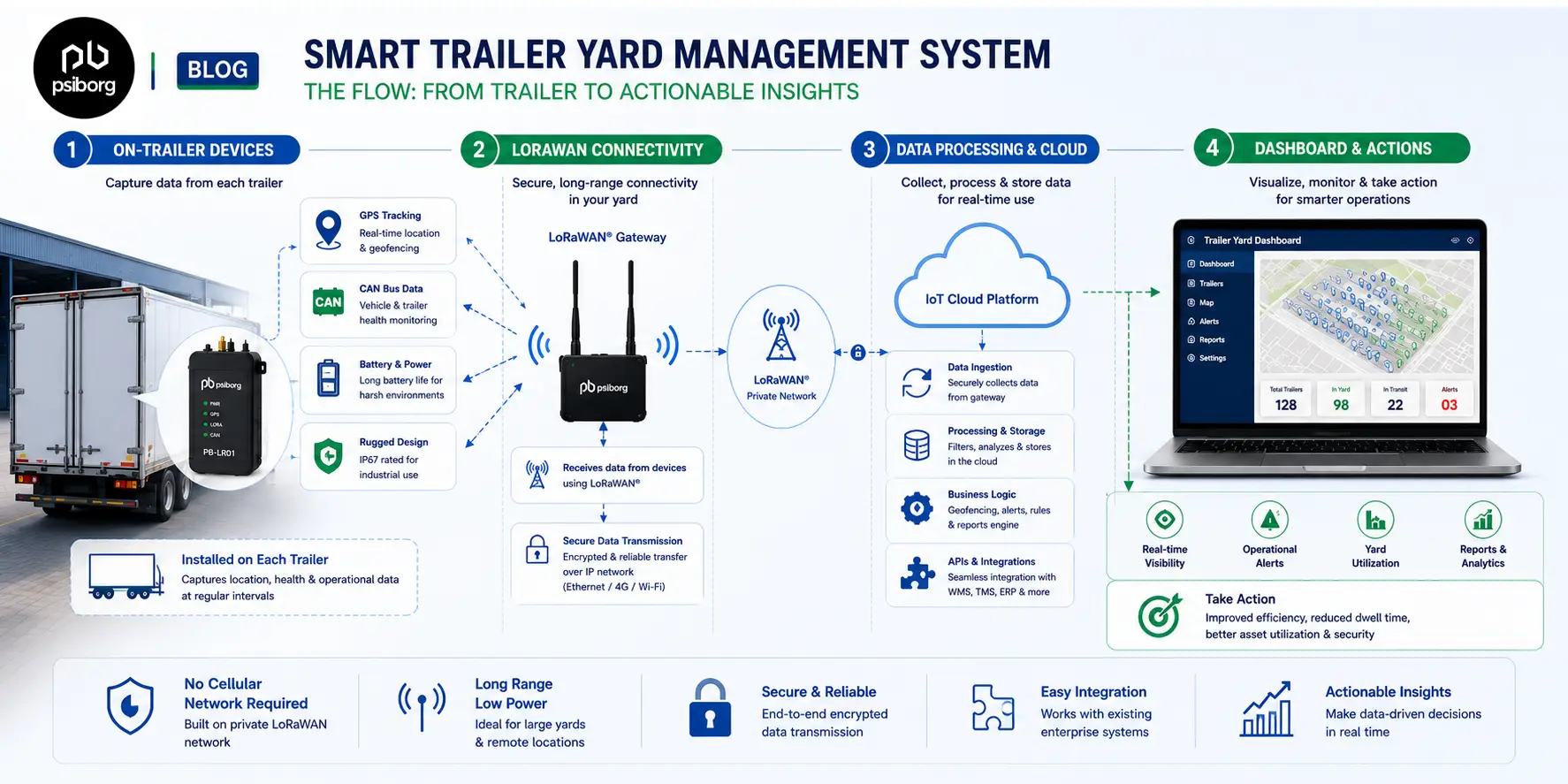
At its core, a Smart Trailer Yard Management System creates a continuous flow of data between the trailer, the facility network, and the operations team. Instead of relying on manual updates or periodic yard checks, the system automatically captures, transmits, and visualizes trailer activity in real time. The architecture typically consists of three key layers working together.
1. The GPS Device
The first layer is the GPS tracking device installed directly on the trailer.Key functions of the device include:
- Physically plugs into the trailer’s power or OBD interface for continuous operation.
- Captures real-time GPS coordinates at configurable intervals, providing constant location visibility.
- Reads CAN bus data when connected to a tractor, including:
- Vehicle speed
- Engine status
- Diagnostic fault codes
- Built for harsh industrial environments, featuring:
- Vibration-resistant design
- Wide operating temperature range
- IP-rated enclosure for dust and water protection
By collecting both location and operational data at the source, the device becomes the foundation of real-time yard intelligence.
2. The LoRaWAN Gateway
Once data is collected, it must be transmitted reliably across the facility. The LoRaWAN IoT gateway serves as the communication bridge between trailers and the management platform:
- Receives GPS and operational data from trailer-mounted devices.
- Operates on a private, unlicensed LoRaWAN network, eliminating dependence on SIM cards, cellular subscriptions, or public internet connectivity.
- Provides long-range coverage of up to 7 km in open industrial environments, allowing a small number of gateways to cover large manufacturing plants, logistics hubs, or mining sites.
- Securely forwards data to cloud-based or on-premise servers for processing and storage.
This private-network approach is particularly valuable in industrial environments where cellular coverage may be unreliable or restricted.
3. The Dashboard
The final layer transforms raw trailer data into actionable operational insights. Through a centralized dashboard, facility managers can:
- View the live location of every trailer on an interactive map.
- Track movement history and route patterns.
- Monitor dwell times to identify bottlenecks and idle assets.
- Configure and manage geo-fenced zones across the facility.
- Receive automated alerts for:
- Incomplete trips
- Geo-fence breaches
- Unauthorized movements
- Engine or diagnostic faults
With real-time trailer data flowing from devices to dashboards, the next question becomes: what communication network should carry that data?
LoRaWAN vs. Cellular for Industrial Trailer Monitoring
Both LoRaWAN and cellular networks can support asset tracking, but they are designed for very different operating environments. While cellular connectivity works well for over-the-road logistics, industrial trailer monitoring often demands a more reliable and self-controlled communication infrastructure.
The comparison below highlights the key differences:
Factor | LoRaWAN (Private Network) | Cellular (4G/LTE) |
Coverage in large yards | Up to 7 km, gateway-based | Dependent on carrier signal |
Works in explosive/mining zones | Yes, no RF interference risk | Often prohibited |
Monthly data cost | None (private network) | Per-SIM subscription |
Battery life of device | Years (low-power protocol) | Months (high-power drain) |
Operates without internet | Yes | No |
Security | Private, encrypted, air-gapped | Public carrier network |
Important Notes: In explosive manufacturing plants or underground mining operations, cellular signals are either unavailable or banned for safety reasons. A private LoRa network is the only viable path to continuous trailer visibility in such environments.
Key Capabilities of a Smart Trailer Yard Management System
As industrial facilities move beyond manual yard operations, the value of a Smart Trailer Yard Management System comes from the operational intelligence it delivers every day. From tracking trailer movements to preventing delays and monitoring vehicle health, these capabilities help transform yard operations from reactive to proactive.
1. Real-Time Trailer Movement Tracking Inside Industrial Premises
GPS devices continuously transmit trailer coordinates through LoRaWAN gateways, giving operators live visibility into trailer movements across the facility. Managers can track a trailer’s journey from the entrance gate to the dock and exit point without relying on radio calls or manual updates.
2. Monitoring Trailer Dwell Time
The system automatically records when a trailer arrives, how long it remains idle, and when it departs. If dwell times exceed predefined limits, alerts are triggered to help prevent delays, detention charges, and inefficient yard utilisation.
3. Geo-Fencing for Industrial Logistics Operations
Virtual boundaries can be created around docks, restricted zones, storage areas, and facility exits. Whenever a trailer enters or exits a geo-fenced area without authorization or at an unexpected time, supervisors receive instant notifications for rapid intervention.
4. Alerting Drivers When a Trip Is Not Completed
The platform compares planned trailer movements with actual routes and timelines inside the facility. If a trailer is delayed, stalled, or fails to reach its assigned destination, automated alerts are sent to drivers and dispatchers, enabling immediate corrective action.
5. CAN-Based Trailer Health Monitoring
When coupled to a tractor, the GPS device can read CAN bus data such as engine status, fuel levels, brake conditions, and fault codes. This allows maintenance teams to identify potential issues early and reduce costly equipment downtime before it impacts yard operations.
As the benefits of real-time trailer visibility become clear, the next question is where these systems deliver the greatest operational value.
Industry-Specific Applications of Smart Trailer Yard Management System
Smart Trailer Yard Management Systems solve different challenges across industries. From hazardous manufacturing environments to large-scale mining operations, the ability to monitor trailer location, movement, and status in real time creates measurable improvements in safety, efficiency, and operational control.
Let’s explore some of the most impactful use cases.
1. Trailer Visibility in Explosive Manufacturing Plants
In explosive and hazardous manufacturing environments, conventional cellular-based tracking solutions are often restricted due to safety regulations. A private LoRaWAN network combined with industrial-grade tracking devices enables continuous trailer monitoring without relying on public communication infrastructure.
This allows operators to maintain real-time visibility of explosive material transport trailers throughout the facility, improving both regulatory compliance and operational safety.
2. Smart Yard Management for Mining Operations
Mining sites often span several kilometres, with trailers and support vehicles moving across vast open-pit areas and remote access routes. Maintaining visibility across these environments can be challenging, especially in locations with limited connectivity.
GPS-enabled LoRaWAN tracking provides continuous location updates, while dwell-time analytics and CAN-based health monitoring help reduce equipment downtime and improve asset utilisation, critical factors in mining productivity.
3. Monitoring Trailer Movement in Manufacturing Facilities
Modern manufacturing facilities depend on tightly coordinated logistics to support Just-In-Time (JIT) production workflows. Even minor trailer delays can disrupt production schedules and create costly bottlenecks.
A Smart YMS automatically tracks trailer movements, ensuring the correct trailer reaches the designated dock at the right time. Automated trip-completion alerts also help prevent production interruptions caused by delayed or misplaced trailer deliveries.
Because every industrial environment has unique operational and safety requirements, a standard tracking solution rarely delivers optimal results.
PsiBorg develops customized Smart Trailer Yard Management systems by tailoring GPS devices, LoRaWAN infrastructure, alerts, geo-fencing, and dashboards to each facility’s specific workflows and hazardous operating conditions.
How PsiBorg Builds a Custom Smart Trailer Yard Management System?
A Smart Trailer Yard Management System is only as effective as the technology architecture behind it. As a full-stack custom IoT solutions provider, PsiBorg Technologies designs and deploys customized Smart YMS solutions tailored to the operational requirements of manufacturing facilities, mining sites, logistics hubs, defence operations, and hazardous industrial environments.
Rather than offering a one-size-fits-all platform, PsiBorg combines IoT hardware, connectivity infrastructure, software, and integrations into a unified solution designed around each client’s workflow.
Key capabilities include:
- Custom GPS tracking devices for real-time trailer visibility.
- Private LoRaWAN network deployment for reliable connectivity without cellular dependency.
- Geo-fencing and automated alert systems for operational control and compliance.
- CAN bus integration for trailer and vehicle health monitoring.
- Real-time dashboards showing trailer location, dwell time, movement history, and utilisation metrics.
- API integrations with existing WMS, TMS, ERP, and industrial management platforms.
PsiBorg’s expertise in industrial asset visibility extends beyond trailer tracking, having also developed smart shipment tracking solutions that provide real-time GPS location monitoring, geo-fencing, route visibility, and operational analytics for industrial fleets operating in challenging environments.
See how PsiBorg implemented a LoRaWAN-based GPS tracking industrial vehicle fleet management solution for a Defence organisation, delivering real-time asset visibility, location tracking, and operational monitoring.
Conclusion
A Smart Trailer Yard Management System goes far beyond basic asset tracking—it gives industrial operators complete visibility and control over trailer movements, utilisation, and operational health. By combining GPS tracking, private LoRaWAN connectivity, geo-fencing, dwell-time monitoring, CAN-based diagnostics, and automated alerts, facilities can reduce delays, improve efficiency, and strengthen compliance. For industries such as mining, defence logistics, and hazardous manufacturing, where reliable connectivity is critical, private-network tracking provides a practical and scalable path to real-time yard visibility.
Looking to build a Smart Trailer Yard Management System for your facility? Contact PsiBorg to discuss a customized IoT solution designed around your operational environment, connectivity requirements, and compliance needs.