Simplifying Logistics With Shipment Tracking System
- Home
- Case Studies
- Simplifying Logistics With Shipment Tracking System
India
Logistic and Supply
Shipment Tracking, Inventory Management, Route Optimization
Project Highlights
- This time, our client is the Indian Defence Organisation, and they asked us for a shipment tracking system and an asset monitoring solution to track the status of their shipments in real-time.
- PsiBorg developed a highly competent entire shipment tracking solution to provide the client with the stability and convenience that they were looking for.
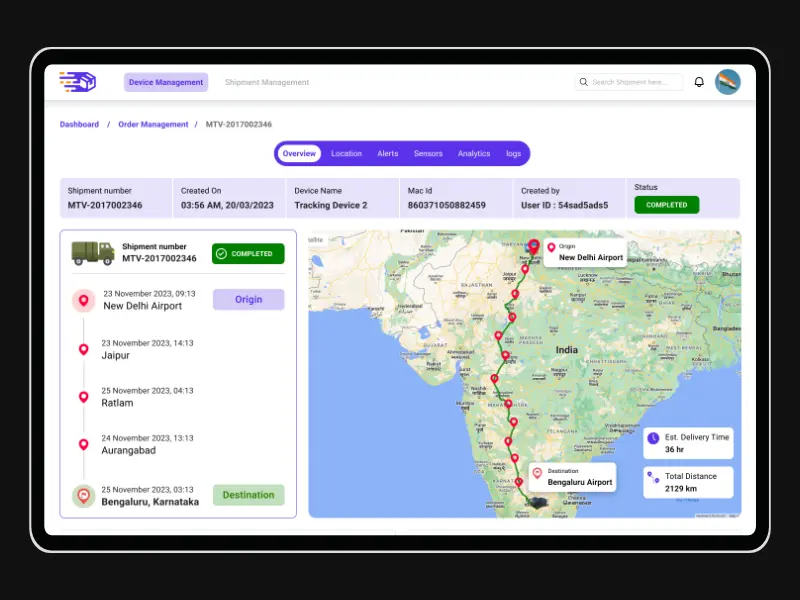
- The shipment tracking system comprises shipment tracking devices and an IoT dashboard and is capable of tracking the vehicle location in real-time, along with the orientation of how the asset is placed in the container.
- We combined IoT sensors with reliable software to make shipment tracking a full activity supervision tool by integrating features like temperature and humidity monitoring, vibrational analysis, geo-location, and G-force to determine the acceleration of the vehicle.

Client Name- INDIAN DEFENCE ORGANISATION
About the Project
The Indian Defence organization has to deal with heavy transportation of their goods all across the country on a daily basis, but they lack visibility and transparency in their operation, which is necessary from a security point of view.
Also, it’s really frustrating to log the tracking data in a spreadsheet only to find out in the end that the data is unreliable, missing, and outdated. Hence, the organization approached PsiBorg Technologies to get an IoT-based tracking solution.
We build an IoT-based cargo tracking devices that can monitor and track the vehicle and valuable assets and provide data in real-time during transit.
Our Innovative Solution
To solve all the above-stated challenges, we designed and developed an IoT-based Shipment tracking device for precise monitoring and tracking of in-transit shipments. We built a system that is a combination of both hardware (an IoT device) and software (an IoT dashboard).
To overcome the network issue, we used NB-IoT as it has deeper penetration, so it can work perfectly even in places with bad network signals and can also save data offline. It will also successfully sync the data to the server when the application is connected to the internet.
Our solution will help monitor vehicle speed, locate real-time remote assets, monitor them, and manage valuable shipments. We developed the solution to make sure the user also gets access to position tracking, be it outdoor positioning of assets or indoor positioning of assets.
Once the device is powered on, the user will have full access to location tracking through sensors over the cloud and will continuously receive shipment tracking status.
We built an IoT based container tracking system that includes features like:
- Real-time Alerts
- Real Time tracking of vehicle
- Live location with Geo-location tracking
- Vibrational analysis
- Temperature and humidity monitoring inside shipment containers
- Orientation monitoring for correct goods handling
- Pre and post-trip notifications
- Tracking total fuel spend and optimizing cost with fuel management
Features
1
Real-time Vehicle Tracking
The smart tracking system continuously monitors shipment location, enhancing visibility and security during transit for better logistics management.
2
Asset orientation
The system allows tracking of the position and orientation of shipments to ensure safe handling and prevent damage during transport.
3
Route Optimization and Planning
The smart solution analyses routes for efficiency, reducing travel time, fuel costs, and improving overall delivery schedules.
4
Location History
It also provides detailed logs of past shipment locations, aiding in performance analysis and improving route planning.
5
Device tempering alerts
Sends immediate alerts if tracking devices are tampered with, making sure shipment security and reducing theft risks.
6
Pre and Post-Trip Notifications
The system notifies stakeholders of trip start and end times, ensuring timely updates and better shipment coordination.
Technology Used




We at PsiBorg are a click away. Please mail to us at info@psiborg.in
Just in case you need to understand anything and everything about IoT, Project requirement.
Projects Challenges
The Defence organization has to send shipments to locations that have internet connectivity issues. An app fails to work correctly in returning live GPS latitude/longitude values to track the vehicles that are in transit.
Therefore, before entering into full-scale implementation, they requested team PsiBorg to create a Proof of Concept (PoC) that can display a fully functional shipment tracking system and our expertise in tracking.
One more challenging aspect was executing successful field trials of the system to ensure almost zero errors.
Result
Our team designed a shipment tracking system to track and monitor the asset in real time, even in places with poor internet. By the end of the PoC, the shipment tracking status obtained from the sensor and dashboard helped the organization make observations that could reduce future damage.
This way, our shipment tracking solution offered complete traceability of vehicles from material loading to delivery and gave a real-time update on the map.
After the PoC success, PsiBorg started working on a full-fledged solution to create a daily trip report, vehicle speed, location mapping, and much more.
The client has been successfully satisfied by the way PsiBorg executed their vision, and we on our end, gained another happy client.
What We Delivered
- IoT Device
- Web-based Admin Panel
- User Panel
- Web App
- Documentations
FAQs
Do GPS shipment trackers work inside metal containers, and where should they be installed?
Yes, but metal walls weaken GPS and cellular signals, so placement and antenna design decide the result. Inside a sealed steel container a tracker may only regain a satellite fix near the doors or after unloading. A weatherproof housing fixed to the container wall, or an antenna with a clear view of the sky, performs better. Battery-powered container trackers also behave differently from vehicle-powered units.
Which connectivity should I choose for shipment tracking in India: NB-IoT, LTE-M or 4G Cat 1 bis?
Choose by the routes the shipment actually travels. NB-IoT is very power-efficient with deep penetration, but its coverage varies by operator and region, and it does not support handoff between cells, which is a drawback for moving assets. LTE-M handles mobility better but has limited availability in India. 4G Cat 1 bis is widely used for asset tracking.
How long does a battery-powered shipment tracker last, and how does reporting frequency affect it?
Battery life depends mainly on reporting interval, signal conditions and which sensors stay active, not on capacity alone. As a rough guide from commercial trackers, one report a day can last several years, hourly reports roughly six months to a year, and frequent reporting far less. Always-on shock monitoring and weak signal drain batteries faster. Adaptive reporting, which sends more often only while the asset moves, balances freshness and life.
How do I set shock and tilt alert thresholds to catch cargo mishandling without false alarms?
There is no universal setting, because thresholds depend on how fragile the cargo is and how it is handled. Too low, and ordinary road vibration buries useful alerts. Too high, and damaging impacts go unrecorded. Useful records include peak g-force, duration, timestamp and GPS position, and tilt limits are set in degrees for orientation-sensitive goods. Common indicator presets include 25 g, 50 g and 75 g, but a threshold signals risk rather than proof of damage, so trial runs on real routes help calibrate it.
What certifications does a GPS tracker or IoT shipment device need before it can be sold or used in India?
Any tracker with a transmitting radio, such as GSM or LTE, Wi-Fi, Bluetooth, LoRa or NB-IoT, generally needs WPC Equipment Type Approval before it can be legally imported, manufactured or sold in India, usually after RF testing at an accredited lab. Devices that connect directly to the public telecom network may also need TEC’s MTCTE certification, and BIS registration applies to some electronics categories.
How does a shipment tracking system integrate with ERP or TMS software, and how is the tracking data kept secure?
Tracking platforms usually expose APIs that ERP, TMS and WMS systems call, with webhooks pushing events such as arrival, route deviation or shock alerts the moment they occur, instead of systems polling on a schedule. Security should cover device identity through certificates or tokens, TLS 1.2 or higher in transit, encryption of stored data, role-based access and secure remote updates.