Duress Alarm System Boosts Staff Safety in Hospitals: See How!
- Home
- Case Studies
- Duress Alarm System Boosts Staff Safety in Hospitals: See How!
India
Hospital
Monitor staff location, staff movement tracking, Instant emergency Alerts, Support contact tracing and infection control.
Project Highlights
- The hospitals face frequent incidents of staff assault and delayed emergency response, creating a challenging safety environment that urgently requires a reliable, real-time alert system customized to healthcare worker vulnerabilities.
- The core idea behind the solution was to combine duress alarm functionality with RTLS technology for precise location tracking, ensuring rapid, accurate response to emergency triggers anywhere within hospital premises.
- PsiBorg approached the challenge by conducting a thorough needs assessment with hospital security and staff members, followed by designing a customized IoT ecosystem containing hardware components- wearable panic badges, fixed alarm stations, and software components including a centralized monitoring dashboard, mobile security alerts app, and integration APIs for hospital security systems.
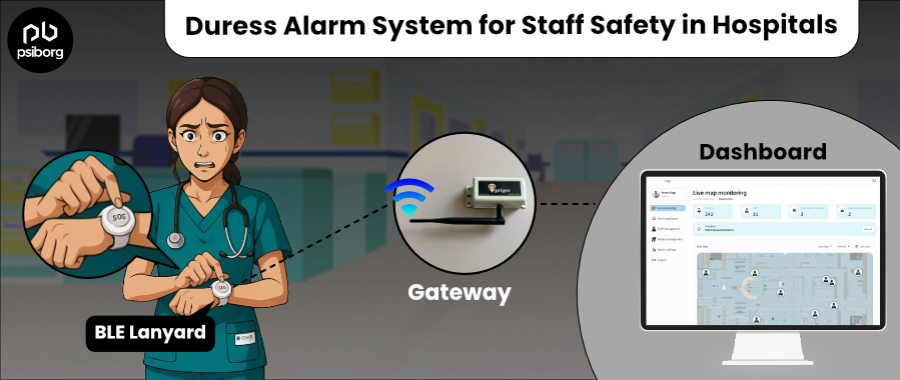
- We at PsiBorg delivered an end-to-end solution that includes user-friendly panic buttons worn as badges or clips with multi-modal alert triggers (manual press, fall detection), a BLE RTLS network for accurate location tracking, and a cloud-hosted monitoring platform featuring live map visualization and automated alarm escalation.
About the Project
Staff safety gaps, especially in high-risk areas like psychiatric wards, demand precise, immediate alert systems. A duress alarm is a discreet emergency device staff can activate to signal distress quickly. In such situations, a duress alarm system is essential, as it delivers precise location tracking for timely intervention, significantly enhancing staff safety and reducing risks.
Our Innovative Solution
- Since at PsiBorg we have already developed a remote patient monitoring system, we used our expertise and created a highly specific hospital staff safety and tracking solution using Bluetooth Low Energy (BLE) beacons.
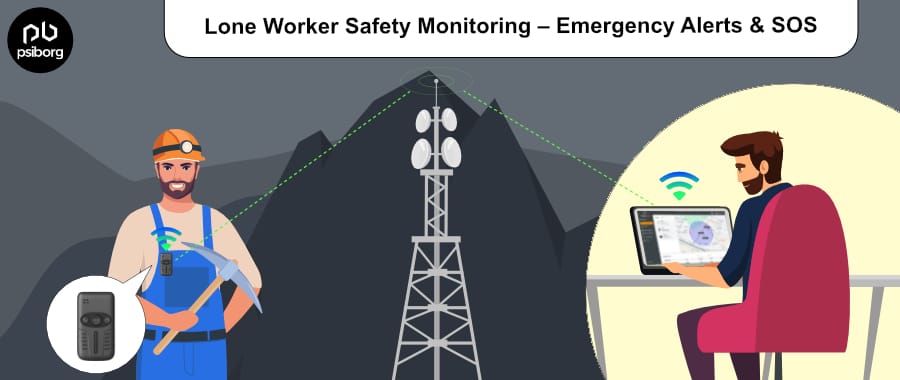
- In this system, every staff member wears a BLE-enabled badge that allows security teams to instantly locate anyone in distress within the hospital premises. This system not only enhances staff safety by enabling rapid intervention but also improves operational efficiency by automating Zonal attendance and staff movement tracking.
- Additionally, the same BLE infrastructure supports medical equipment tracking. The medical equipment tracking software ensures that vital devices such as infusion pumps, ventilators, and wheelchairs are always locatable, reducing search times during critical moments and optimizing asset utilization. This dual functionality supports seamless asset tracking in hospitals while prioritizing staff protection.
By combining staff monitoring and smart asset tracking into one unified, cloud-based platform, PsiBorg transformed hospital safety and resource management, helping healthcare providers deliver safer and more efficient care.
What We Delivered
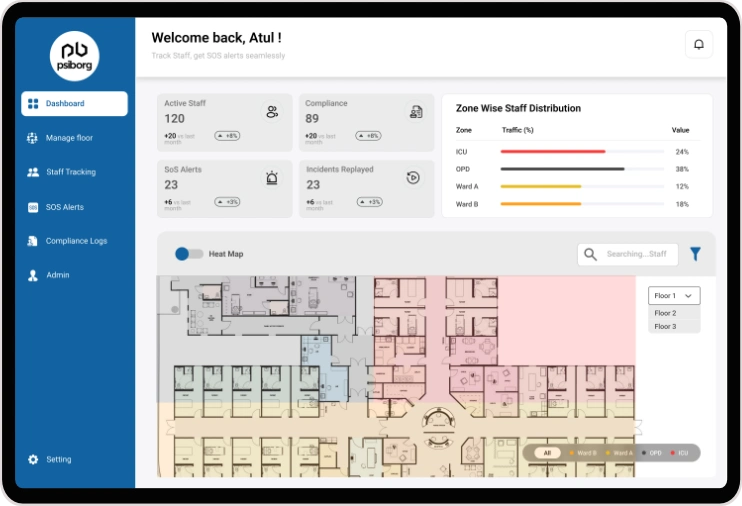
Mobile/Web app for on-the-go tracking and alerts
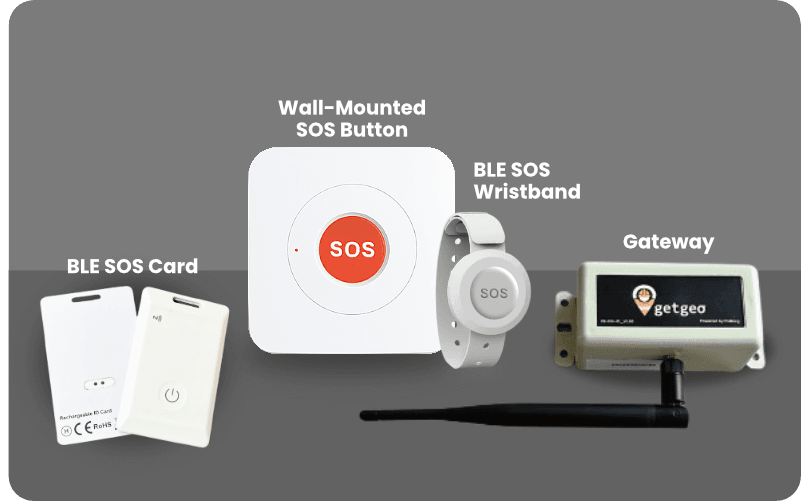
BLE-based wearable badges for staff & Strategically placed BLE gateways
Features
1
Real-Time Location Tracking
The system uses BLE beacons to provide precise, real-time location data of staff during emergencies, allowing rapid and accurate response to distress alerts.
2
Instant Duress Alarm Activation
Staff can discreetly trigger an emergency alert with a single button press on their wearable badge, immediately notifying security while keeping the situation confidential.
3
Long Battery Life & Durable Design
Smart wearable devices are compact, lightweight, and designed for long battery life with antimicrobial surfaces, ensuring durability and hygiene in demanding hospital environments.
4
Medical Equipment Asset Tracking
Using the same BLE network, the system tracks critical medical equipment, reducing search times and ensuring availability when needed.
5
Automated Incident Reporting & Analytics
The platform logs incidents automatically and provides detailed analytics, helping hospitals comply with regulatory standards and improve future safety protocols.
Technology Used

We at PsiBorg are a click away. Please mail to us at info@psiborg.in
Just in case you need to understand anything and everything about IoT, Project requirement.
Projects Challenges
Designing the system to provide precise real-time location tracking within complex and varied hospital layouts, including isolated wards and multi-floor facilities, posed a significant technical challenge requiring advanced Bluetooth Low Energy network optimization and strong signal processing.
Integrating the duress alarm system seamlessly with existing hospital security infrastructure and workflows demanded extensive customization and testing to guarantee reliable alarm notification, and minimal false alarms without compromising response speed.
Ensuring user adoption was challenging due to staff resistance to new technology, requiring comprehensive training programs and intuitive wearable device design to minimize disruption and gain trust for consistent usage in high-stress environments.
Result
PsiBorg successfully developed and delivered an advanced staff safety solution customised for hospitals. Our expertise in developing tracking and monitoring solutions and IoT in healthcare solutions enabled us to design a system that ensures rapid emergency response through real-time location tracking and instant duress alarm activation.
The integrated platform improves availability, reduces losses, and supports regulatory compliance, making hospitals safer and more efficient.
Key benefits include:
- Rapid emergency response with immediate alerts and precise location tracking.
- Increased staff confidence leading to reduced stress and turnover.
- Increased operational efficiency by automating Zonal attendance and movement tracking.
- Improved asset utilization, ensuring vital equipment is always available.
- Support for regulatory compliance with detailed incident logs and analytics.
As an IoT company that provides custom product development services, we are skilled at developing user-friendly hardware and software that satisfies client’s needs. Read more of our success stories to learn how PsiBorg’s innovative IoT solutions like patient management systems can safeguard your frontline healthcare workers and optimize resource management.
Improve your hospital’s safety with Psiborg’s innovative solutions. Contact us today!
FAQs
Are duress alarms or wearable panic buttons mandatory for hospitals?
Requirements vary by country and rarely name a specific device. In the US, Joint Commission-accredited hospitals have had to run workplace violence prevention programmes since January 2022, covering risk assessment, incident reporting and staff training, but the standards don’t mandate wearable alarms. India has no single central law for healthcare worker safety; some state laws, such as Kerala’s 2023 amendment, allow rules on CCTV, control rooms and alarm systems. A duress system built on IoT in healthcare practice with RTLS location logging helps document incidents.
Which works best for hospital staff duress: a wearable badge, a fixed panic button or a smartphone app?
Each suits a different situation. Fixed buttons are reliable and always powered but protect only people who can reach them. Smartphone apps reuse existing devices, but unlocking a phone and tapping an app is slow and difficult during a confrontation. Wearable badges travel with staff, need a single discreet press, and can report location through a BLE or RTLS network. Most hospitals use a hybrid: wearable SOS devices for mobile clinical staff, plus fixed buttons at reception, triage and isolated rooms.
Is BLE-based real-time location tracking safe to use around ICU monitors, infusion pumps and other sensitive medical equipment?
BLE badges are low-power transmitters, typically milliwatt-level, far below a mobile phone’s peak output, and medical devices are tested for immunity under IEC 60601-1-2. Even so, standards don’t guarantee zero risk in every setting, so hospitals normally validate wireless hardware before deployment. Choose radio-certified, well-designed hardware, pilot-test in sensitive areas such as ICUs, operating theatres and neonatal units with biomedical engineering, and follow the hospital’s wireless policy.
Should a hospital duress alarm system run on-premises or in the cloud?
It depends on how much the alarm path must survive outages. Safety-critical alerting is usually kept on-premises, or at the local edge, so alarms and escalation keep working if the internet drops and respond without a remote round trip. Cloud hosting suits analytics, remote access, multi-site reporting and lower upkeep. Many hospitals choose a hybrid: a local server handles detection and escalation, while the cloud handles dashboards and reports. Also check data-residency rules, backup power and failover.
How can hospitals make sure panic badges still work when needed, including battery life, supervision and testing?
A badge is only useful if its failure is noticed. Choose devices that report low battery well before it runs out and send periodic check-ins, so a silent or offline badge shows up on the dashboard. Battery life depends on activation frequency and location-beacon settings; published duress badges range from about 18 months to several years. Add a battery check at the start of each shift and regular system-wide tests from real locations.