Smart Washroom Management System for Better User Comfort
- Home
- Case Studies
- Smart Washroom Management System for Better User Comfort
India
Smart Washroom
Real-Time Occupancy Monitoring, Resource Management, Water Leakage Detection and Odor Control
Project Highlights
- An IoT-based Smart Washroom Monitotring System is a solution designed to enhance the hygiene, and user experience in washrooms, particularly in high-traffic commercial and residential facilities.
- Let’s Connect India is a modern workspace provider located in Noida. They offer private offices, meeting rooms, and event spaces to support professionals from diverse backgrounds.
- They want us to build a custom-based smart washroom management system that checks if the washroom is in use, how many people are inside, how full the dustbins are, and if the soap dispensers need refilling.
- This system offers real-time monitoring of restroom metrics such as occupancy, dustbin levels, soap dispenser status, and overall cleanliness. It also provides a web application with an admin dashboard for centralized management and a screen for users to see the occupancy of people inside the washroom.
Client Name- Let’s Connect India
Our Innovative Solution
- To address these challenges, PsiBorg adopted an effective approach for designing and implementing a smart washroom monitoring system.
- Firstly, our team thoroughly researched and analyzed the client’s specific needs, focusing on washroom occupancy monitoring, resource monitoring, and maintenance metrics to design the system accordingly.
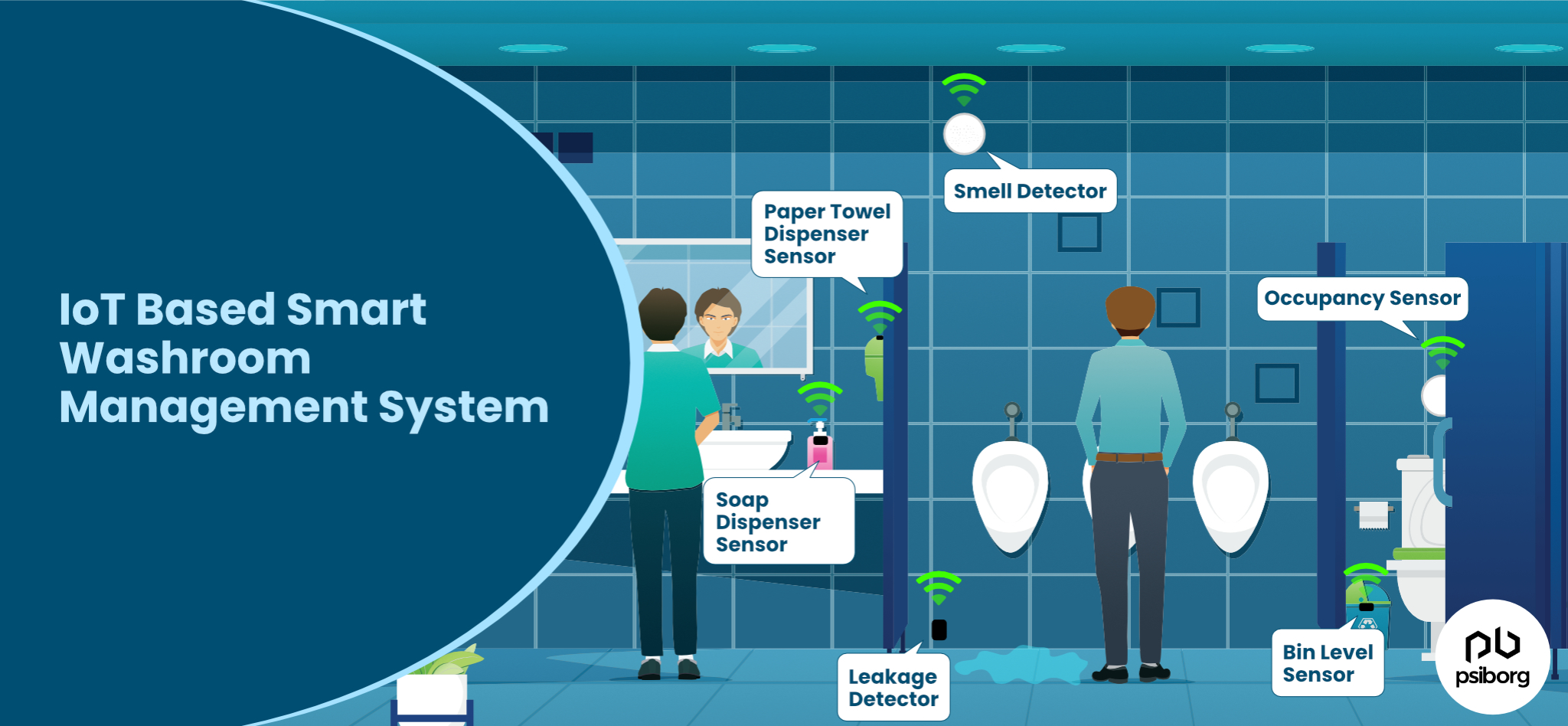
- As a result, we decided to build a custom-based solution that integrates various IoT sensors including occupancy sensors, soap dispenser monitors, waste bin fill-level sensors, water leakage detectors, people counter sensor and smell detectors with a centralized dashboard for real-time monitoring and management.
- The washroom monitoring system allows administrators to monitor sub-admins and their work progress in real time.
- Additionally, it displays the real-time status of occupied and vacant restrooms which help users to quickly locate available facilities, improving customer convenience and satisfaction.
What We Delivered

Mobile/Billboard App, User/Admin Dashboard

Smart Washroom Monitoring Devices
Features
1
Real-time Washroom Monitoring
The smart washroom management system allows continuous monitoring of washroom facilities in real-time such as occupancy, cleanliness, and supply levels. It ensures that any changes are detected instantly which help to maintain hygiene and operational efficiency.
2
Admin Dashboard (with Sub-admin Access)
This feature provides a centralized platform to manage multiple washrooms. With the help of system, it allows super admins to monitor sub-admins and their work progress which ensures better control and management of washroom facilities.
3
Restroom Occupancy Monitoring
The smart washroom monitoring system shows the occupancy status of a washroom, indicating whether it is vacant or occupied, helps customers to easily find available restrooms, and enhances the user experience.
4
Waste Bin Fill Level Monitoring sensor
The system track the fill level of waste bins in real-time and give alert when bins are nearly full. It ensures timely waste disposal, preventing overflows and reduces unnecessary checks.
5
Soap Dispenser Level Monitoring sensor
It tracks the soap dispenser levels and send alerts when refills are needed. It prevents soap shortages, ensuring that washrooms are always stocked and better customer satisfaction.
6
People Counter
This feature counts the number of people using the washroom and displays the queue status. It helps in planning cleaning schedules based on usage, ensuring washrooms are available and clean when needed.
7
Water Leakage Detection
The system can detect water leakage in real-time, preventing water wastage and potential damage.
8
Smell Detector
The toilet smell detector monitors odor levels in the washroom and sends alerts if cleaning is required. It ensures that the washroom remains fresh and pleasant for users.
9
Toilet Paper Fill Level Monitoring Sensor
This feature tracks toilet paper levels in real-time and sends alerts when refills are needed. It ensures that washrooms are always stocked with toilet paper, reducing user inconvenience.

We at PsiBorg are a click away. Please mail to us at info@psiborg.in
Just in case you need to understand anything and everything about IoT, Project requirement.
Project Challenges
Integrating multiple types of sensors for occupancy, soap dispenser levels, water leakage, and waste bin monitoring required careful planning to ensure seamless communication and data accuracy across the system.
As the system expanded to cover more washrooms, it needed to process large amounts of data without delays or performance issues. We had to ensure the platform could handle increased traffic, maintain data accuracy, and support seamless operation across all locations. This required scalable architecture and robust optimization to ensure the system stayed reliable and efficient, even as the workload grew.
Ensuring accurate monitoring of washroom conditions such as occupancy, resource usage, water leakage and smell detection was another challenge. This solution involved optimizing sensor technologies and implementing complex algorithms to maintain precise readings and reliable system performance.
Result
The implementation of the IoT-based Smart management washroom system has resulted in improved washroom management, hygiene and user satisfaction across facilities.
Our solution provides a reliable and proactive system for real-time washroom monitoring which ensures cleanliness, resource availability and a pleasant experience for users.
The smart washroom management system has been successfully integrated into Let’s Connect India workspace with key features such as:
- Real-time monitoring of washroom occupancy, waste levels, resource usage.
- Automated maintenance alerts for cleaning, refills, and repairs.
- Centralized admin dashboard with sub-admin access for better management and allocate resources effectively.
- Improved hygiene through proactive monitoring of soap dispensers, toilet paper, waste bins, water leakage and odor detection.
FAQs
How can facility managers switch from fixed cleaning schedules to usage-based washroom cleaning?
Start by measuring real usage. Install people counters at the entrance and fill-level sensors on soap, paper, and bins for a few weeks to build a baseline. Then set triggers, such as a visit count, a low consumable level or an odour threshold, that create a cleaning task instead of waiting for the next round. A smart restroom solution with an IoT dashboard can push these alerts to supervisors’ phones, so staff move from lightly used toilets to busy ones.
Why is LoRa often preferred over Wi-Fi or Bluetooth for battery-powered sensors in washrooms and commercial buildings?
LoRa uses sub-GHz radio, so signals pass through walls and floors better, and one gateway can often cover a whole building. Its low data rate suits small, periodic readings such as occupancy counts or fill levels, and battery-powered sensors can last months to years, whereas Wi-Fi nodes typically need far more frequent charging. The trade-off is bandwidth, so it is unsuitable for video or large payloads. A common design pairs LoRa sensors with a gateway that uploads over Wi-Fi or Ethernet.
Can washroom occupancy sensors count people without cameras or breaching privacy laws?
Yes. Washroom systems should avoid cameras and use non-imaging sensors instead, such as infrared or time-of-flight door counters and PIR or radar presence sensors. These output only counts and occupied/vacant status. With no images or device identifiers captured, the data is anonymous and aggregated, reducing exposure under rules like GDPR and India’s DPDP Act, which apply to data about identifiable individuals. Store only counts, limit retention, and have legal counsel confirm.
Can smart washroom sensors be retrofitted into an existing building without rewiring, and how long do the batteries last?
Yes. Battery-powered wireless sensors can be fitted to existing washrooms without new cabling. Door-mounted people counters, adhesive-mounted level sensors for soap, paper and bins, and wall-mounted gas sensors for odour all report over low-power radio to a gateway, so only the gateway needs mains power. Battery life depends on reporting interval, sensor type, and traffic. Multi-year life is common for level and odour sensors, while PIR sensors in busy sites can drain faster than rated, so schedule periodic health checks.
Can a smart washroom management system integrate with existing CAFM, BMS or ticketing tools?
Usually yes, provided the platform exposes open APIs or webhooks. Sensor events, such as a low-soap alert or a visit-count threshold, are mapped to locations in the CAFM or ticketing tool and turned into work orders with priorities and completion logs. A building management system can use occupancy data to adjust lighting and ventilation. Before buying, ask about REST APIs, MQTT support, authentication, data retention and who maintains the connectors.