BLE Beacon-Based Rider Arrival Detection for Quick Commerce Delivery
- Home
- Case Studies
- BLE Beacon-Based Rider Arrival Detection for Quick Commerce Delivery
India
Quick Commerce, Food Delivery, Last-Mile Logistics
Rider Arrival Detection, Restaurant Proximity Detection, Kitchen Dispatch Sync, Real-Time Rider Proximity Alerts.
Beacon-Based Rider Arrival Detection -Highlights
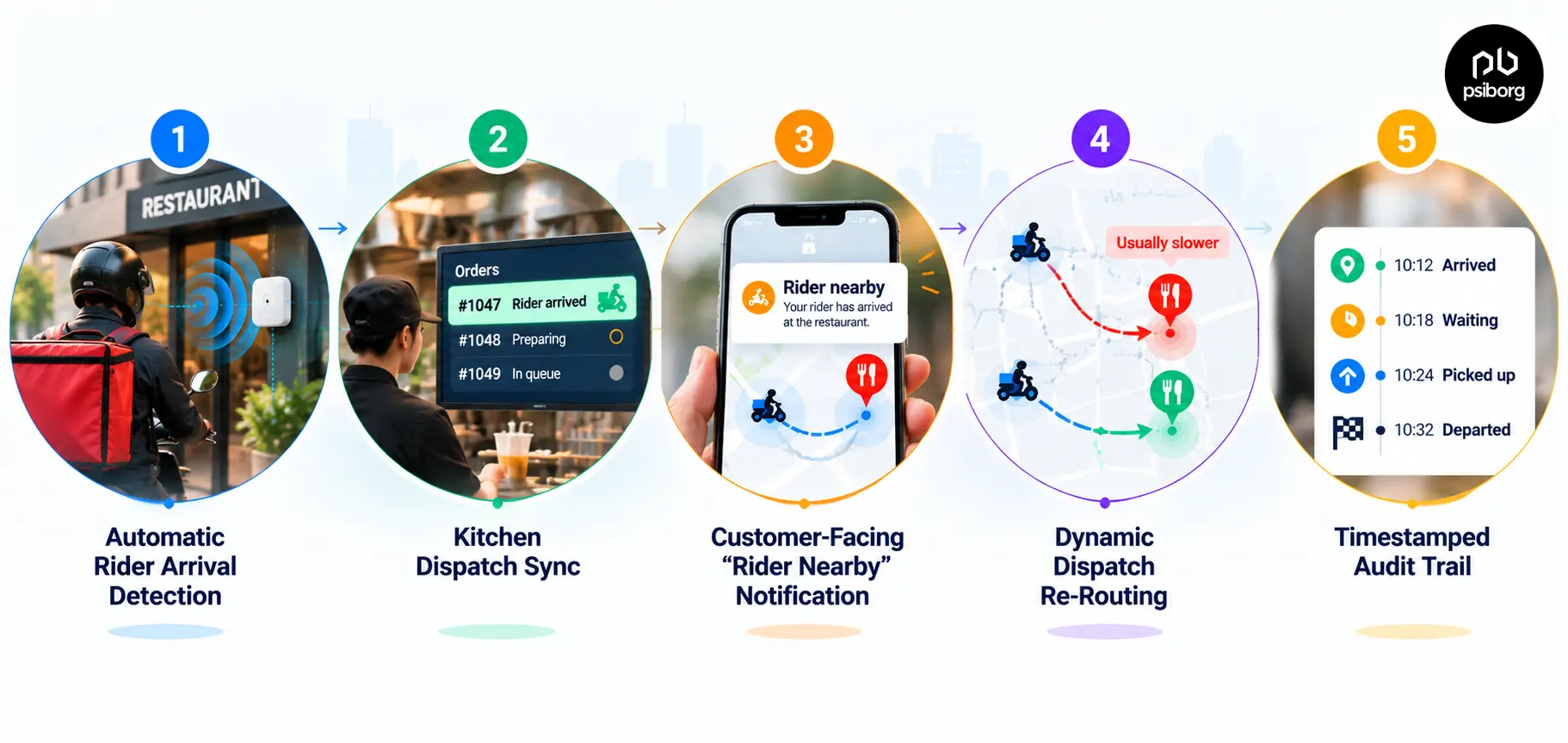
- Verified arrival at the exact pickup point: a BLE beacon at the restaurant handover counter confirms the rider is physically there, replacing manual “arrived” taps and unreliable GPS pins.
- Customer-facing “rider nearby” notification: the customer’s app is nudged the moment the rider is confirmed at the restaurant, improving perceived transparency and cutting “where is my order?” queries.
- Dynamic dispatch re-routing: real-time dwell-time data feeds the dispatch algorithm, which learns which outlets run slow and adjusts rider allocation accordingly.
- One timestamped record for kitchen sync and SLA disputes: arrival, wait and departure are logged per order and synced to the kitchen, so the platform, restaurant and rider work from the same facts.
Client Testimonial

“By confirming rider arrival at the exact restaurant handover point, we can reduce reliance on manual arrival updates and GPS-based assumptions. The timestamped arrival and waiting-time records also provide better coordination between riders, restaurants, and our dispatch team, enabling us to identify delays and make more informed dispatch decisions.”
About the Project
- Quick commerce lives and dies on minutes. India’s quick commerce segment is projected to reach about Rs 1.08 lakh crore in 2026, growing roughly 40% year on year. As order volumes climb, every avoidable minute at the pickup point multiplies across thousands of daily deliveries.
- The pickup stage is also the least transparent part of the journey. Riders report “arrived” from the parking area or the street. Kitchens mark food “ready” with no idea whether a rider is outside. Customers see a static ETA. When an order runs late, the platform, the restaurant and the rider each hold a different version of events, which drives up support load and SLA disputes.
- GPS alone cannot close this gap. Satellite signals weaken inside and around dense buildings, malls, and basement or mall-based food courts, so a rider standing at the counter and a rider waiting two floors above can look nearly identical on a map. Platforms that want to reduce food delivery SLA disputes need a signal that is tied to the exact pickup location.
- A BLE beacon-based approach addresses this directly. Because BLE works at short range and is designed for low-power proximity sensing, it can confirm that a rider is within a few metres of the pickup point, which is the same principle behind PsiBorg’s RTLS indoor tracking work, applied here to last-mile delivery.
Our BLE Beacon-Based Rider Arrival Detection Ecosystem
Building on PsiBorg’s experience in BLE beacon solutions and IoT asset tracking and monitoring, we designed a system that covers the full pickup lifecycle, from the beacon at the restaurant to the decision made in the dispatch dashboard.
- Beacons at the pickup point. A battery-powered BLE beacon is installed at each partner restaurant or dark-store kitchen, positioned at the handover counter so its signal represents “at the pickup point” rather than “somewhere on the premises.” Each beacon broadcasts a unique ID tied to one outlet.
- Detection in the rider app. The rider’s Bluetooth Low Energy delivery IoT mobile app scans for nearby beacons. When the signal strength crosses a calibrated threshold and holds for a short confirmation window, the app registers a verified arrival. The confirmation window filters out riders who briefly pass the entrance without stopping.
- Event pipeline in the cloud. The arrival event, with outlet ID, rider ID and timestamp, is sent to the cloud, where it is validated and routed to the order management and dispatch services.
- Kitchen dispatch sync. The arrival triggers an update on the kitchen’s order screen, that is sort of IoT Dashbaord, so the kitchen knows to finalise packing, and the departure event closes the dwell-time measurement. This kitchen dispatch sync removes the guesswork about when food should be ready.
- Customer and dispatch intelligence. The confirmed arrival feeds the customer app and the dispatch engine, which are covered in the features below.
What We Delivered - Device and Web and Mobile App sdk
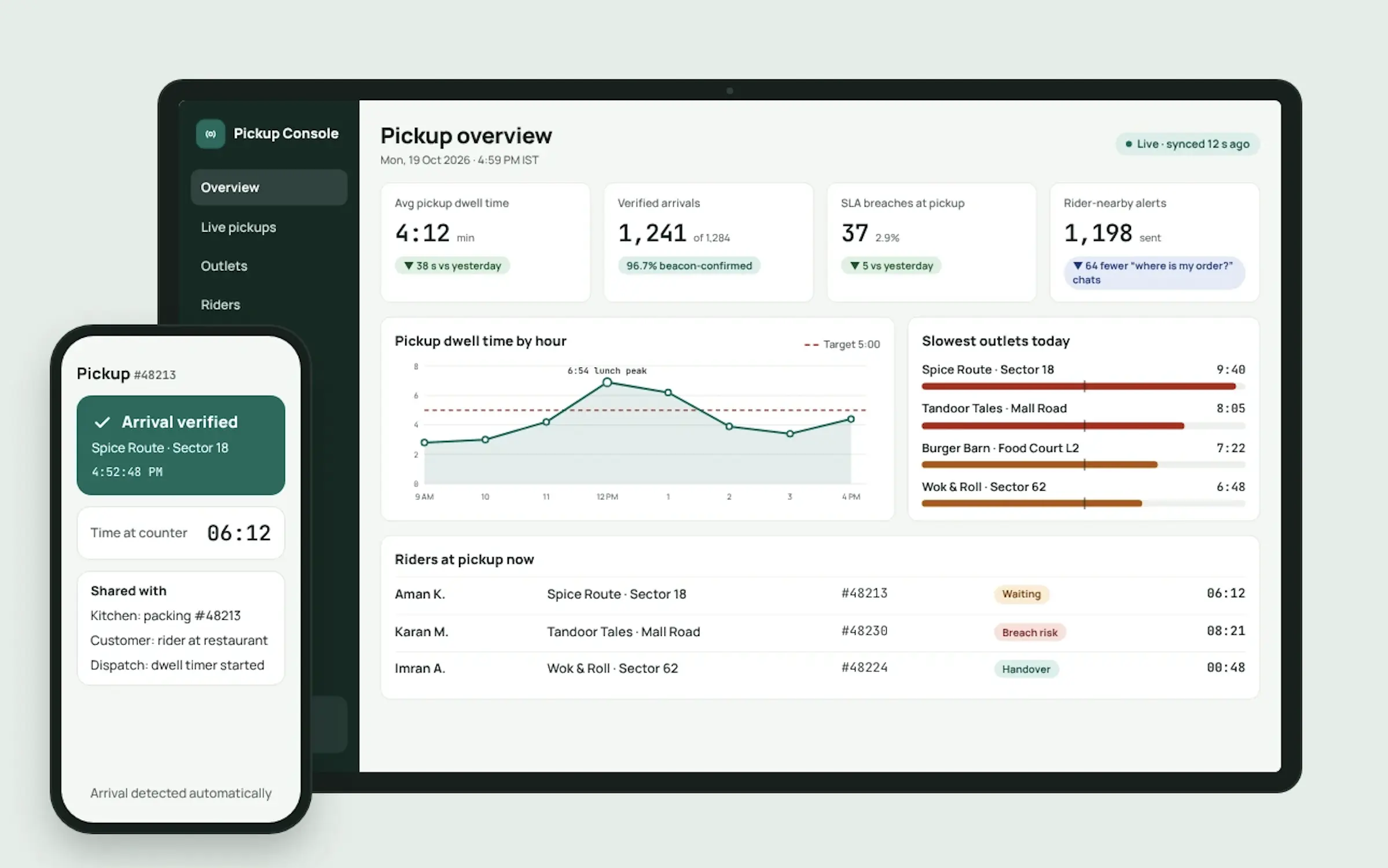
Cloud-Based Multi-User Dashboard and Mobile App
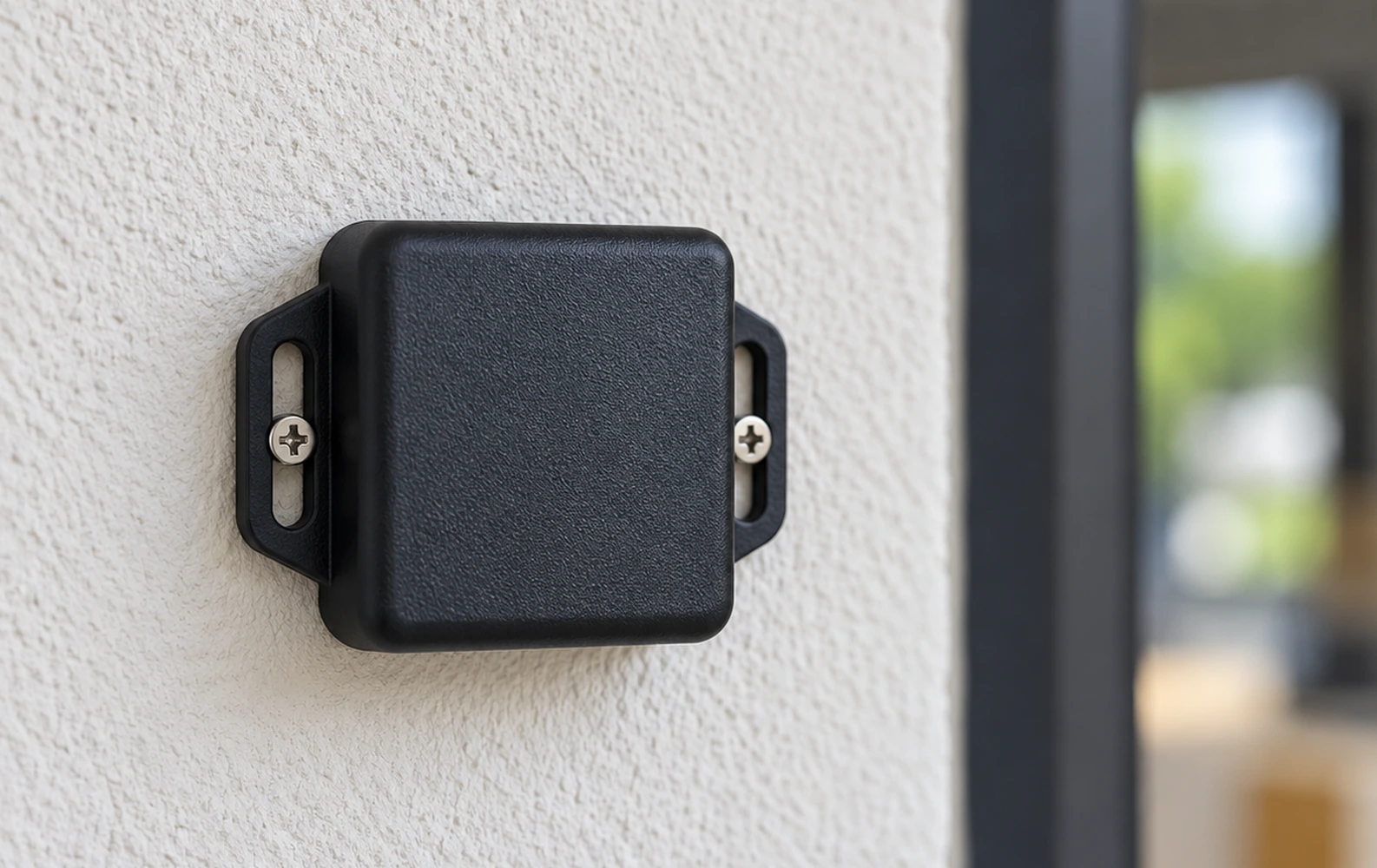
BLE Beacon
Features of Beacon based Rider Detection Solution
1
Automatic Rider Arrival Detection
BLE proximity confirms when a rider is physically at the pickup point, replacing manual “I’ve arrived” taps. Arrival and departure are logged automatically with timestamps, giving every outlet a reliable pickup record.
2
Kitchen Dispatch Sync
The moment a rider is confirmed at the restaurant, the kitchen’s order screen updates. Teams can prioritise orders whose rider is already waiting, instead of working through the queue blind.
3
Customer-Facing “Rider Nearby” Notification
The customer’s app is nudged the moment the rider is confirmed at the restaurant, improving perceived transparency. Customers see real progress instead of a frozen ETA, which reduces “where is my order?” contacts. This is real-time rider proximity alerts working on the customer’s side of the journey.
4
Dynamic Dispatch Re-Routing
Real-time dwell-time data flows back into the dispatch algorithm, so it learns which outlets consistently run slow and adjusts rider allocation accordingly. Riders are no longer sent early to kitchens that routinely need extra preparation time.
5
Timestamped Audit Trail for SLA Disputes
Every arrival, wait and departure is recorded against a verified location signal. When a pickup delay is disputed, the platform, restaurant and rider can all refer to the same record.

We at PsiBorg are a click away. Please mail to us at info@psiborg.in
Just in case you need to understand anything and everything about IoT, Project requirement.
Project Challenges
Signal behaviour in busy kitchens. Metal counters, steel shelving, crowds and handheld devices all distort BLE signal strength. Beacon placement, transmit power and RSSI thresholds had to be tuned outlet by outlet to separate a rider at the counter from one standing outside.
Avoiding false arrivals. A rider walking past a restaurant should not trigger an arrival. We addressed this with a distance-based confirmation so only specific proximity counts.
Integrating with live operations. The arrival signal had to flow into existing order management, kitchen display and dispatch systems without disrupting orders already in flight, which required careful API design and phased rollout.
Result
PsiBorg designed, built and deployed a BLE beacon-based rider arrival detection system that gives quick commerce operations a verified view of the pickup stage for the first time
Key benefits of our Becon based proximity detection system :
- Verified, timestamped rider arrival at the exact pickup point
- Better kitchen readiness through dispatch sync
- Greater customer transparency through proximity notifications
- Smarter rider allocation as the dispatch algorithm learns slow outlets
- Low-cost, low-power hardware that scales across outlets
What We Delivered:
- BLE beacon hardware
- Rider-app arrival detection module
- Cloud event pipeline and dispatch dashboard
As an IoT solutions company providing custom IoT product development services, PsiBorg brings end-to-end capability from embedded firmware and beacon hardware to cloud integration and mobile apps. Explore our other success stories, including our BLE beacon-based crowd management system, to see how PsiBorg’s BLE and RTLS solutions work across industries.
Building location-aware delivery technology? Contact us today.
FAQs
How does BLE detect rider arrival at a restaurant?
A small BLE beacon at the pickup counter continuously broadcasts a unique ID. The rider’s app listens for it and measures the received signal strength (RSSI), which rises as the rider gets closer. When the signal crosses a set threshold and stays there for a short confirmation window, the app records a verified arrival and sends it, with a timestamp, to the platform. Departure is detected the same way when the signal fades. PsiBorg’s BLE beacon solutions use this principle for proximity detection.
Why not just use GPS?
GPS depends on a clear line of sight to satellites, and that signal weakens around dense buildings and indoors. A GPS pin may show a rider near a restaurant but cannot reliably tell whether they are at the counter, in the lobby or on another floor. BLE works at short range and sits at the exact pickup point, so it answers the question platforms actually need answered. As PsiBorg explains in its guide to RTLS for indoor tracking, GPS is built for outdoor use while indoor systems rely on beacons and tags.
How accurate is BLE compared with GPS for delivery apps?
BLE proximity systems typically resolve location to within a few metres, around 3 to 5 metres for RSSI-based setups according to PsiBorg’s RTLS overview. For arrival detection, the key advantage is not raw accuracy but relevance: BLE confirms presence at a specific point, while GPS estimates position on a map. Many platforms use both, with GPS for the route and BLE for the final pickup confirmation.
How does this help reduce SLA disputes?
Disputes usually arise because the platform, restaurant and rider each record different arrival and pickup times. A BLE system creates one verified, timestamped record of arrival, wait and departure for every order. When a delay is questioned, everyone can see whether it happened because the food was not ready or because the rider arrived late.
Does the rider need to do anything, and will it drain their phone battery?
No manual action is needed, since detection runs in the background of the delivery app. BLE is designed for low-power operation, and scanning can be tuned to run only when a rider is near an assigned pickup.
Can this integrate with our existing dispatch and kitchen systems?
Yes. The arrival and departure events are delivered through APIs, so they can feed existing order management, kitchen display and dispatch engines. PsiBorg builds the beacons, rider-app module and IoT dashboard, and integrates with the systems already in use.