WiFi Based Home Automation System: Your Home, Your Way
- Home
- Case Studies
- WiFi Based Home Automation System: Your Home, Your Way
India
Automation & Security
HVAC, Smart Home Appliances, Smart Energy Meters
Project Highlights
- The client is a leader in making smart homes and delivers powerful home automation solutions. They asked us to develop a product through which users can have complete control over their homes with just a few taps on their phones.
- The project objective was to design a hardware system that can be connected to every sensor that is needed to attain a unified and harmonious home automation system.
- We also had to design an Android and web app for the users to monitor their home/office with ease.
Client Name- CYNETIX
About the Project
Our client, Cynetix, offers smart home products and is an expert in creating personalized IoT based home solutions. PsiBorg helped Cynetix by developing a WiFi based home automation system that includes a mobile-based app that works with Wi-Fi and LoRa communication technology. It also responds to voice commands given to devices through Alexa or Google.
Our Innovative Solution
When the client approached us with a requirement for a WiFi based home automation system, we proposed a solution that facilitates multiple layers of security and communication to connect all IoT-enabled devices.
We put forth a capable architecture of home automation for both short-range and long-range, using multiple communication technologies like LoRa, a server-based LoRa gateway, and Wi-Fi connectivity.
This integrated system can efficiently control different home appliances and maintain smart management of all the electronic components.
Our team chose the LoRa network because it is a revolutionary technology when it comes to long-range communication using ultra-low power. LoRa technology also offers simultaneous radio communication.
In addition to this, we used PIR sensors, motion sensors, Aeotec multi-sensors, vibration sensors, sound sensors, and electric usage sensors. These sensors are integrated into the project for fire/CO detection, leak/moisture detection, and window & door opening and closing.

Features
1
Remote Control
Control lights, thermostats, and appliances from anywhere using a smartphone or other device.
2
Smart Appliances
Connect appliances to the internet for remote control, scheduling, and energy efficiency.
3
Electricity Saving
Optimize energy consumption through smart thermostats and lighting, reducing utility bills.
4
Voice Control
Interact with your home using voice commands for hands-free operation.
5
Elegant Touch Panels
Control your smart home with sleek, intuitive touchscreens located within your home.
6
Alarm System
Protect your home with advanced security features, including sensors, cameras, and alerts.
Technology Used





We at PsiBorg are a click away. Please mail to us at info@psiborg.in
Just in case you need to understand anything and everything about IoT, Project requirement.
Projects Challenges
Home automation is not a recent innovation, however, there is still a minimal fraction of the population that is leveraging the benefits of WiFi-based home automation systems.
Because majority of the users want a fully-fledged smart home working app, they don’t want to add devices and rooms to the app by themselves. Also, homeowners want to be notified about any fire/intrusion on their property, no matter where they are.
Also, there is a strong need for smart home automation systems that are intuitive and easy to use, even for individuals with minimal technical knowledge. Simplified interfaces, voice control, and centralized platforms are the answer to all these challenges.
Result
WiFi based home automation system is one of the projects in which our team holds expertise. Although the project was a big success, our team developed a home security and automation system with Google voice assistance that provided a smart way to control home appliances and ensure safe and secure data transfer and communication.
We have developed an all-around WiFi based home automation system that includes:
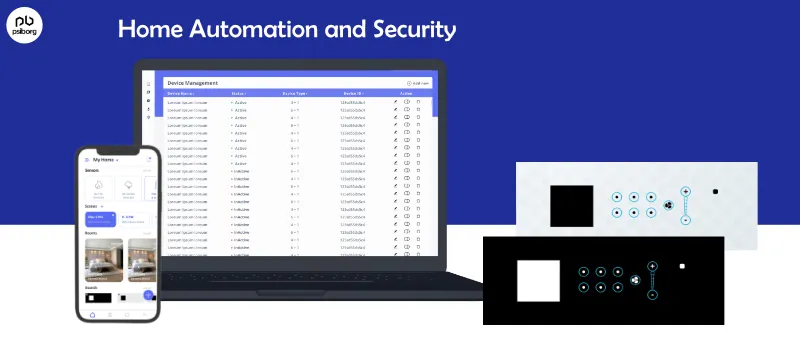
- Smart and elegant touch panels: Easy-to-install and operate smooth touch switches to control the temperature, lighting, and overall appeal of the room
- Mobile app: A mobile app that will make your home fully automated, as you can control everything in the house with a simple click.
- A voice assistant: A home automation system with Alexa and Google Assistant integration lets you control your appliances using your voice.
Our team contribution allowed our client to focus on higher-level product offerings to customers.
What We Delivered
- Touch Panel
- PCB
- Web Application: Admin Control Panel
- App
FAQs
Should a smart home use Wi-Fi, Zigbee, Z-Wave or LoRa?
It depends on range, power and device count. Wi-Fi gives high data rates and wide device support, but uses more power and strains routers when dozens of devices connect. Zigbee and Z-Wave are low-power mesh protocols that suit battery sensors, reaching roughly 10–100 metres per hop. LoRa travels much farther at very low power but carries small data packets. Many products combine them: Wi-Fi for panels and appliances, a low-power link for sensors.
How does Alexa and Google Assistant voice control work with a custom smart home product?
The device connects to the manufacturer’s cloud, and the voice assistant connects to that cloud. For Alexa, the manufacturer builds a Smart Home Skill with account linking; Google Home uses a similar cloud-to-cloud integration. The assistant turns a spoken command into a request, your cloud passes it to the device, and the device acts. Matter, an interoperability standard, can reduce per-platform work for supported device types.
How can a smart home detect fire, intrusion and water leaks and alert me when I’m away?
Combine sensors with a connected hub and phone notifications. Typical inputs are motion (PIR) and vibration sensors, door and window sensors, sound sensors, fire/CO detection and leak or moisture sensors. The hub reads them, and the cloud sends a push alert to the owner’s app wherever they are, while a panel or siren can sound locally.
What does it take to develop a custom smart touch panel and control board for home automation?
A custom touch panel needs hardware design (touch interface, power section and wireless modules), a PCB layout that fits the wall enclosure, and firmware for control logic and connectivity. It also needs cloud and app integration so panel, phone and voice commands stay in sync. Testing and field trials follow before production.
Can a smart home system still work when the internet or Wi-Fi goes down?
It depends on how the system is built. Cloud-dependent features, including most voice assistant commands, stop without internet because requests route through the voice service and the manufacturer’s cloud. Local control keeps working when the system uses a local gateway, physical touch panels and local protocols; Matter, for example, runs over the local network without needing the cloud. Designers can also put sensors on a separate low-power link such as LoRa so sensor-to-gateway links don’t depend on home Wi-Fi.
How do I launch a white-label smart home product with an IoT development partner?
Start by defining the scope: devices such as touch panels and sensors, connectivity, mobile and web apps, an admin dashboard, voice assistant support and the cloud backend. A development partner then handles hardware and PCB design, firmware, apps and integration, while your brand focuses on positioning and customers. Plan certification for your target markets early, since late hardware changes are costly.